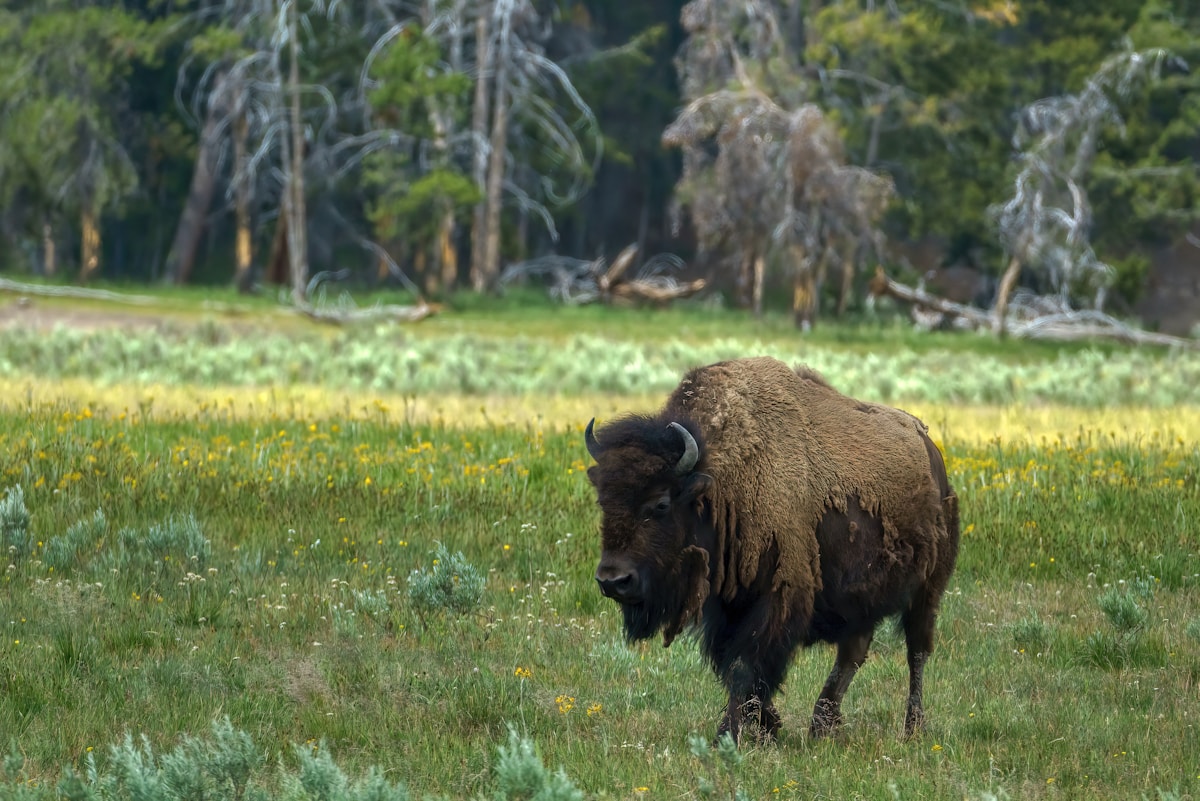
The US contains some of the most accessible large mammal wildlife in the world - a consequence of the national park system, which has protected large predator and prey populations since the late 19th century. The combination of protected land, managed ecosystems, and predictable animal behavior (particularly where wildlife is accustomed to human presence) creates conditions for wildlife watching that most countries can’t replicate. This guide covers the primary species, locations, and seasons for serious wildlife watching across the country.
Bison - Yellowstone National Park, Wyoming
The American bison nearly went extinct in the 19th century; an estimated 30–60 million animals were reduced to fewer than 1,000 by 1889. Yellowstone’s herd - descended from a remnant population that survived in the Pelican Valley - now numbers approximately 4,500 to 5,000 animals, one of the largest free-roaming herds on the continent.
Best viewing areas:
- Lamar Valley (northeast Yellowstone) - called “the Serengeti of North America,” the Lamar Valley floor hosts large bison herds visible from the road year-round. Dawn and dusk are most active. The valley is accessible from the Northeast Entrance road (Cooke City, MT) even when most of the park is snowbound.
- Hayden Valley (central Yellowstone) - similarly flat valley floor with large herds visible from numerous pullouts along the Grand Loop Road.
Rut season: Late July through September. Bulls challenge each other and move constantly across the valley floors - the most dramatic bison behavior of the year.
Practical notes: Yellowstone bison cause the most injuries of any animal in the park - not because they are aggressive but because visitors approach too closely. The Park Service requires a minimum distance of 25 yards from bison. A bison charging from 30 yards will reach you in 2–3 seconds.
Grizzly and Brown Bears - Katmai National Park, Alaska
Katmai National Park (Brooks Camp, Alaska) is the definitive bear watching destination in the world. Each July and September, brown bears congregate at Brooks Falls and the Brooks River to intercept sockeye salmon migrating upstream. The concentration of large bears - sometimes 20–30 individuals simultaneously - creates wildlife viewing that has no equivalent anywhere in North America.
Brooks Falls Bear Platform: A viewing platform at the falls allows visitors to observe bears fishing salmon directly below. The falls are fully accessible to day visitors who fly in to Brooks Camp. Entry to Katmai National Park is free; access requires a floatplane from King Salmon, Alaska (approximately 60 miles).
Cost: Round-trip floatplane from King Salmon to Brooks Camp runs approximately $500–$650/person as of 2026. Bear viewing tours from Anchorage (which include the floatplane) run approximately $650–$900/person for a day trip.
Seasons:
- July: Early salmon run; bears fish at Brooks Falls in large numbers
- September: Second salmon run; bears are hyperphagia (eating constantly before hibernation) and concentrations are very high
- October: Fat Bear Week, when the park webcam hosts a popular “fattest bear” competition - a useful proxy for peak September body condition
Brooks Camp accommodation: The Brooks Camp Campground (accessible by reservation through recreation.gov) allows overnight stays. The Brooks Lodge operates cabins at approximately $750–$950/person/night as of 2026 including meals - extremely expensive but eliminates the daily floatplane cost. Both book months in advance.
Katmai webcams: The park’s live webcams stream bear activity at Brooks Falls during peak season - one of the internet’s genuinely compelling wildlife resources (explore.org/katmai).
Alternative: McNeil River State Game Sanctuary (north of Katmai) offers the most concentrated brown bear viewing in the world but requires Alaska Department of Fish and Game permit allocation - competition is intense, and costs are higher. Katmai is more accessible.
Manatees - Crystal River and Blue Spring, Florida
West Indian manatees (sea cows) congregate in Florida’s warm springs and coastal rivers when Gulf of Mexico water temperatures drop below approximately 68°F (20°C) - typically November through March.
Crystal River National Wildlife Refuge (Crystal River, FL) is the only federal refuge specifically managed for manatee protection. The Kings Bay area of the refuge has the highest winter manatee concentration on the Florida coast.
- Snorkeling with manatees: Multiple Crystal River operators offer guided snorkel tours to observe manatees in the warm spring water. Tours run approximately $30–$55/person as of 2026. Season: November–March.
- Operators: River Ventures (riverventures.com), Plantation Adventure Center. All require visitors to follow passive interaction guidelines - do not touch, chase, or block manatee movement.
Blue Spring State Park (Orange City, FL, near Daytona Beach) hosts a large manatee aggregation in the Blue Spring run, visible from boardwalks at no additional cost beyond park entrance (approximately $6/vehicle as of 2026). Peak viewing is December–February. Fewer than 100 in warm weather; 400+ documented during cold snaps.
Population status: Florida manatees have recovered significantly from near-extinction status, with the population estimated at approximately 8,000–9,000 animals as of recent counts. An unprecedented die-off in 2021–2022 due to seagrass loss raised conservation concerns - verify current population data before 2026 trips.
Gray Wolves - Yellowstone National Park
Wolves were reintroduced to Yellowstone in 1995 after a 70-year absence. The reintroduction is one of conservation’s most documented success stories - and Yellowstone is now one of the few places in the contiguous US where wolf sightings are reliably achievable.
Best viewing areas:
- Lamar Valley - The Lamar Canyon Pack and other Lamar Valley packs are the most watched wolf populations in the world. Wolf biologists and dedicated wolf watchers (“wolf geeks,” in park vernacular) position in the valley at dawn and dusk with spotting scopes. Joining this community is the most reliable way to locate wolves - ask anyone with a scope pointed at the hillside.
- Hayden Valley - A second pack territory; less consistent than Lamar but productive.
Best seasons: Winter (November–April) is the best time for wolf sightings - snow increases track visibility, elk concentrations are higher in valley floors, and wolves are more active in cold weather. Dawn is the peak activity window.
Spotting equipment: A spotting scope (20–60x magnification) dramatically increases sighting odds. Several wolf watchers in Lamar Valley will share their scopes with interested visitors. Binoculars (8–10x) are useful for confirming a distant animal but insufficient for detailed observation.
Guided wolf watching: Yellowstone Wolf Tracker (wolftracker.com) runs guided dawn wolf watching excursions from Gardiner and Silver Gate, MT. Half-day tours approximately $100–$150/person; full-day approximately $175–$225. Guides know current pack territories and are significantly more efficient than self-directed searching.
Bald Eagles - Various Locations
The bald eagle’s recovery from near-extinction in the 1960s to widespread abundance today is one of conservation’s clearest success stories. Today, an estimated 350,000+ bald eagles exist in North America, concentrated in the Pacific Northwest, Alaska, and the Great Lakes.
Best viewing locations:
- Klamath Basin, Oregon/California (November–March): The largest concentration of wintering bald eagles in the contiguous US - up to 1,000 eagles winter here to hunt waterfowl. The Lower Klamath NWR and Tule Lake NWR are the focus areas. Viewing is from car or on foot along refuge roads.
- Skagit Valley, Washington (December–February): Bald eagles congregate along the Skagit River to feed on spawned-out salmon. Approximately 500–700 eagles winter in the valley. The Rockport area (Highway 20) is the viewing corridor.
- Chilkat Eagle Preserve, Alaska (October–January): The world’s largest concentration of bald eagles - 3,000–4,000 birds - gather along the Chilkat River near Haines, AK, where warm springs keep the river ice-free and late salmon runs persist. Viewing from the Bald Eagle Preserve road alongside the Haines Highway. Fly or ferry into Haines from Juneau or Skagway.
- Conowingo Dam, Maryland (November–January): Eagles gather below the Conowingo Dam on the Susquehanna River to feed on stunned fish passing through the turbines. Accessible day trip from Philadelphia or Baltimore - parking on the road adjacent to the dam is free.
General tips: Eagles are most active in morning light. Cold weather concentrates fish in predictable locations, which concentrates eagles. A telephoto lens (300mm+ equivalent) is needed for useful photos from most viewing sites.
National Park Viewing Ethics
For all wildlife - bison, bears, wolves, manatees - the minimum viewing distances posted by each agency are safety requirements, not suggestions. They exist because human-habituated wildlife that causes injuries is typically euthanized by management agencies. Maintaining distance protects both you and the animal. Use optics; don’t close the gap.
Wildlife is wild and does not perform on schedule. Sightings are more likely with the correct season, time of day, and location, but are never guaranteed. Allow extra time, move slowly when near wildlife, and treat a missed sighting as normal rather than exceptional.
Top US Wildlife Experiences at a Glance
Prices as of 2026. Book wildlife tours across the USA on GetYourGuide.
| Experience | Location | Best Season | From | Book |
|---|---|---|---|---|
| Brown bear watching at Brooks Falls | Katmai NP, Alaska | Jul + Sep | ~$500 (floatplane from King Salmon) | Book on GYG |
| Guided wolf watching | Yellowstone, WY (Lamar Valley) | Nov–Apr | ~$100 half-day guided | Book on GYG |
| Bison watching (rut season) | Yellowstone, WY | Late Jul–Sep | ~$35 park entry | Book on GYG |
| Snorkelling with manatees | Crystal River NWR, FL | Nov–Mar | ~$30–55 guided snorkel | Book on GYG |
| Bald eagle viewing | Klamath Basin, OR/CA | Nov–Mar | Free (refuge roads) | Book on GYG |
For guided wildlife watching tours - particularly for spotting bears, wolves, and marine mammals - browse wildlife tours and activities across the USA. A rental car is essential for reaching most wildlife viewing areas. Arrange travel insurance before any remote or wilderness trip.
Related Guides
- Anchorage travel guide
- Yellowstone National Park guide
- Denali National Park guide
- Best time to visit Yellowstone
- Jackson Hole travel guide
- Grand Teton National Park guide
- Everglades National Park guide
- Olympic National Park guide
- Whale watching in the USA
- Camping in US national parks
- 14-day National Parks itinerary