New Orleans and Nashville are both defined by their music - one by jazz and the other by country - but they’re genuinely different cities with different rhythms, different food cultures, and different types of travellers who feel at home in each. This comparison works through the key decisions: music, food, nightlife, cost, and vibe, so you can choose the right one for your trip.
Quick Verdict
| Category | New Orleans | Nashville |
|---|---|---|
| Hotel cost (mid-range) | $140–220/night | $160–260/night |
| Overall daily budget | $80–260 | $85–260 |
| Music genre | Jazz, blues, brass bands | Country, Americana, bluegrass |
| Live music cost | Free to $15 (Frenchmen St) | Free (Broadway honky-tonks) |
| Signature food | Po’boys, beignets, gumbo | Hot chicken, meat and three |
| Nightlife vibe | Caribbean-influenced, late and loose | Party-focused, bachelor/bachelorette heavy |
| Best for | Food, culture, unique American history | Country music, Southern energy, easy fun |
| Peak season cost | Mardi Gras (extreme) | CMA Fest / summer weekends |
| Days needed | 4–5 | 3–4 |
Music: The Central Comparison
New Orleans is the birthplace of jazz - and it remains the most saturated live music city in America by square mile. Frenchmen Street in the Marigny neighbourhood runs a half-dozen serious music clubs within a few hundred metres: Snug Harbor for modern jazz ($5–15 cover), d.b.a. for a rotating roster of jazz, blues, and funk ($5–15), and The Spotted Cat for traditional jazz (no cover most nights, $1 cover on weekends). These are working musicians playing real sets for local audiences, not tourist showcases. The music starts at 8pm and runs to 2–4am every night of the week.
Preservation Hall on St Peter Street in the French Quarter is the formal face of New Orleans traditional jazz - a tiny 1700s-era building with no bar, no frills, and exceptional musicians playing short rotating sets. Tickets run $25–40 per person and need to be booked ahead. It’s one of the most intimate live music experiences in the United States.
Nashville’s music scene operates on a different axis. The Grand Ole Opry at Opryland (opened 1927) remains the flagship - a proper concert hall with a stage framed by the original Ryman Auditorium wooden circle. Weekend Opry tickets run $90–130 for good seats; Tuesday shows cost $50–75. The Bluebird Café in Green Hills is smaller and more intimate: a songwriter showcase format where four writers perform original songs in the round, accompanied by the story behind each one. Tickets run $15–20 and sell out well ahead.
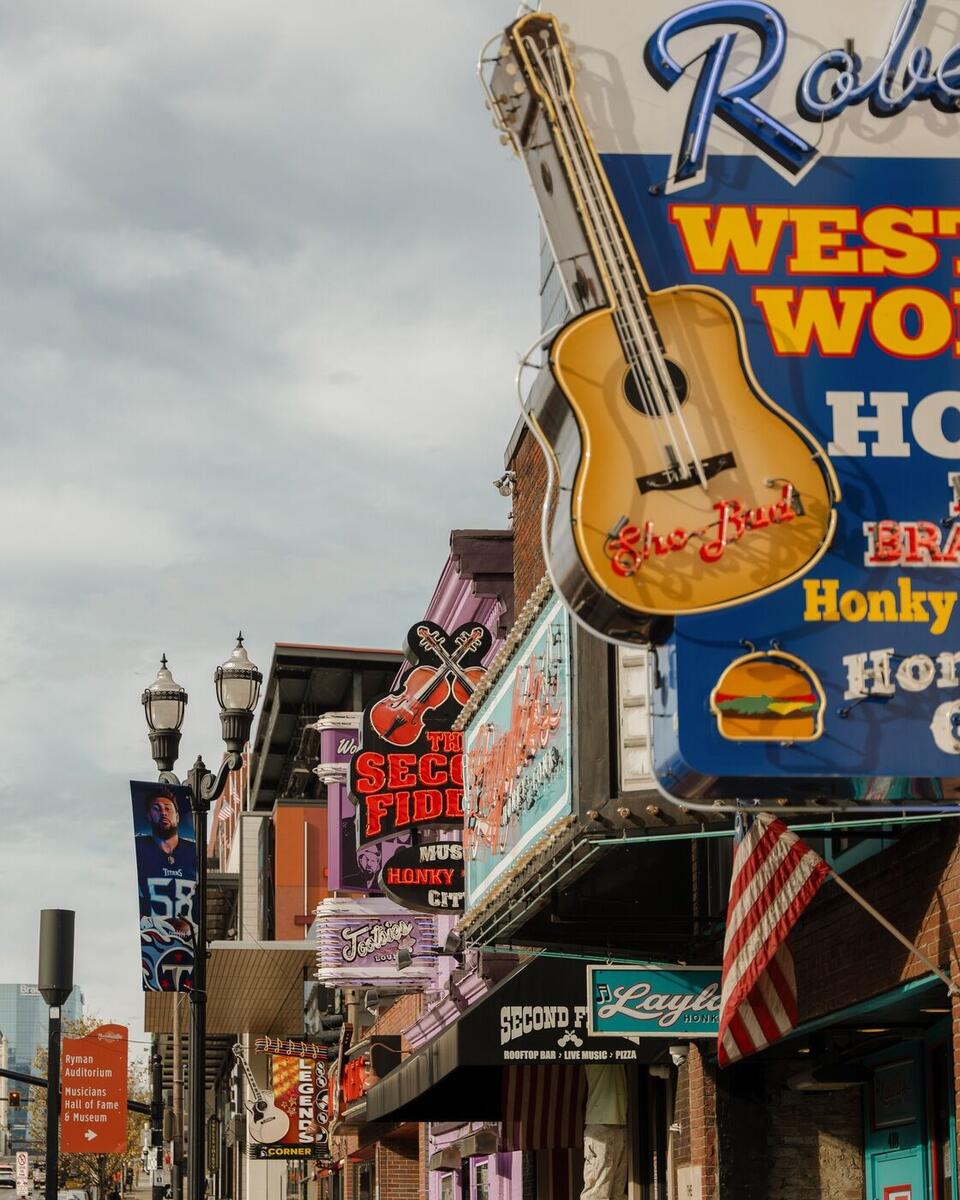
But Nashville’s greatest live music value is entirely free. Lower Broadway’s honky-tonk bars - Tootsies Orchid Lounge, Robert’s Western World, Legends Corner, The Stage, Honky Tonk Central - charge zero cover, ever. Live music runs from noon to 3am daily. Bands rotate every hour. The quality varies from raw to excellent, and the energy on a Friday night is formidable. Nashville’s entire Broadway strip is a free all-day music festival with a two-drink minimum implied but never enforced.
Rule of thumb: if you care deeply about jazz, blues, and music with European and African-Caribbean roots, New Orleans is one of the world’s great music cities. If country, bluegrass, and the songwriter tradition is your preference, Nashville is the world capital.
Food Culture
New Orleans has one of the most distinctive and cohesive food cultures in the United States. Creole cuisine - which draws on French, Spanish, West African, and Indigenous influences - produces dishes that exist nowhere else: gumbo, étouffée, red beans and rice, jambalaya, and the po’boy sandwich. Café Du Monde on Jackson Square serves beignets (three to an order, $5–8) and café au lait around the clock and has done so since 1862. A full roast beef or shrimp po’boy at a Marigny lunch counter runs $12–18. Central Grocery’s muffuletta - a round Sicilian loaf loaded with Italian cured meats, olive salad, and provolone - costs $18–22 and comfortably feeds two.
Fine dining in New Orleans reaches a high level that’s underappreciated nationally. Commander’s Palace in the Garden District ($90–140 per person for dinner, jacket required) is one of the most celebrated restaurants in the South. Brennan’s on Royal Street in the French Quarter, famous for its eggs Benedict and bananas Foster brunch, runs $65–100 per person. August, Galatoire’s, and the Warehouse District’s newer restaurants represent a broader modern New Orleans dining scene. See our New Orleans food guide for neighbourhood-by-neighbourhood recommendations.
Nashville’s food identity is built around different icons. Nashville Hot Chicken - a fried chicken preparation with a cayenne-heavy paste applied after frying, served on white bread with pickles - is the city’s signature dish. Prince’s Hot Chicken Shack (the original, since 1945) and Hattie B’s (more accessible, multiple locations) serve plates for $12–18. Arnold’s Country Kitchen, a meat-and-three cafeteria in SoBro, is the best introduction to traditional Southern plate lunch: a main (meat loaf, fried catfish, country-fried steak) plus three sides (mashed potatoes, collard greens, mac and cheese) for $12–18.
Nashville’s fine dining scene has grown dramatically since 2015. The Catbird Seat (12-seat tasting menu, $165–185 per person) is one of the more interesting restaurants in the South. Henrietta Red in Germantown ($70–120 per person) does exceptional Gulf oysters and raw seafood. The city now has a genuinely serious restaurant culture. See our Nashville food guide for the full picture.
Food verdict: New Orleans wins on distinctive food culture, depth of history, and value for quality. Nashville wins on hot chicken and a growing modern dining scene, but the Creole tradition is one-of-a-kind.
Nightlife and Vibe
New Orleans nightlife is famously unregulated - open container laws permit drinking on the street, bars have no closing time, and the city’s culture is broadly relaxed about public celebration. Bourbon Street is the most visible face of this: loud, tourist-dense, and commercially oriented, with cover charge bars, strip clubs, and souvenir shops. It’s worth an evening but not representative of the city’s best nightlife.
Frenchmen Street in the Marigny, a 10-minute walk from the Quarter, is where the city’s actual nightlife lives. It’s walkable, mostly free or low-cover, and the crowd is a genuine mix of locals and visitors. The clubs are small - capacity 80 to 200 - and the music is excellent. On weekends, the street itself becomes a block party, with food trucks, brass bands busking outside, and an easy flow between venues.
Nashville’s nightlife is concentrated on a narrower strip of Lower Broadway with a more homogeneous energy. The honky-tonks are excellent and genuinely free, but the overall atmosphere skews heavily toward bachelorette parties, bachelor parties, and large group tourism. On weekend nights, Broadway can feel like a single extended event. This is not a criticism - it’s an extremely high-energy, sociable atmosphere that many visitors love. But it’s worth knowing ahead of time if you prefer a more local-feeling night out.
East Nashville, across the Cumberland River, provides the antidote: independent bars and restaurants with a neighbourhood feel, including The 5 Spot (live music, $5–8 cover) and Dino’s (dive bar with good music, no cover).
Costs in Detail
Both cities have roughly similar mid-range budgets, with New Orleans slightly cheaper outside festival season.
Accommodation:
- New Orleans Marigny or Garden District B&B: $140–220/night before the 15.75% hotel tax; $180–290 all-in
- New Orleans French Quarter 3-star: $150–250 before tax; $210–320 all-in
- Nashville SoBro or Gulch 3-star: $160–260 before tax; $230–350 all-in
- Nashville East Nashville Airbnb (2 people): $70–110/person - Nashville’s best-value accommodation option
Food:
- Budget eating: New Orleans $25–40/day; Nashville $25–40/day - roughly equivalent
- Mid-range: New Orleans $65–100/day; Nashville $65–100/day - similar
- The key difference appears at the fine dining tier, where Commander’s Palace and Brennan’s represent a more established high-end tradition in New Orleans
Getting around:
- New Orleans: RTA streetcar ($1.25/ride) covers the French Quarter, Garden District, and the riverfront - one of the great urban transit bargains in the US. 3-day Jazzy Pass: $9.
- Nashville: Almost entirely rideshare-dependent ($10–25 per trip). No useful light rail in the tourist core.
Our full New Orleans trip cost guide and Nashville trip cost guide break down every budget tier with sample day costs.
Weather and Best Time to Visit
New Orleans has four distinct but compressed seasons. Spring (March–May) is the best overall time - warm without the brutal summer humidity, post-Mardi Gras, and festival-rich (Jazz Fest in late April/early May). Summer (June–August) is genuinely difficult: highs of 90–96°F with humidity that pushes the feels-like temperature above 100°F. October and November are excellent - 70–80°F, low humidity, and the city’s food and music scene in full swing without peak-season prices.
Nashville has more conventional temperate seasons. Spring (March–May) and fall (September–November) offer the best weather (60–75°F) and the best combination of moderate prices and manageable crowds. Summer is warm (85–92°F) and increasingly busy with convention and tourism traffic. CMA Fest in early June brings 80,000+ visitors and inflates hotel prices significantly. Nashville winters are mild compared to Chicago or New York - highs of 40–55°F, rarely below freezing for extended periods - and hotel prices drop 30–40% from summer peaks.
Who Should Go Where
Choose New Orleans if: you care about food at a deep level and want a cuisine you can’t find anywhere else in the US; you love traditional jazz, blues, and brass band music; you want a city with a genuinely unique history and European-Caribbean character; or you’re visiting in spring or fall.
Choose Nashville if: country music and the songwriter tradition is your passion; you want a highly energetic, sociable weekend trip; you’re travelling with a group that loves honky-tonks and free live music; or you want a city that’s easy to navigate on foot in its tourist core.
For first-time visitors to either: Nashville is slightly more straightforward - the tourist core is compact, the price point is clear, and the entertainment is immediately accessible. New Orleans rewards those who go beyond Bourbon Street. Spend two nights in the French Quarter and two in the Marigny, eat at a neighbourhood diner, and take the St Charles streetcar through the Garden District - the city reveals itself gradually.
For more regional context, see our Nashville vs Austin comparison and New Orleans vs Charleston comparison. The city guides for New Orleans and Nashville cover logistics, neighbourhoods, and the best neighbourhoods to stay in.
Search hotels in New Orleans | Search hotels in Nashville
Browse New Orleans tours and experiences and Nashville tours and music experiences for the highlights of each city.
Plan Your Trip
✈️ Book your flights to the USA 🛡️ Get travel insurance 📱 Stay connected with an eSIM