Overview
The Outer Banks are a 200-mile chain of barrier islands off the coast of North Carolina, separated from the mainland by a network of shallow sounds - Currituck, Albemarle, Croatan, Pamlico, and Core. The islands are narrow, rarely more than a mile wide, and in places just a few feet above sea level. They absorb the Atlantic’s energy so the mainland behind them does not.
The landscape is almost entirely open: wide beaches, rolling dunes, salt marshes, and maritime forest. There are no cities, no high-rise hotel districts (a height restriction of 35 feet applies across most of the Outer Banks), and relatively few trees. What the Outer Banks offers is beach - mile after mile of undeveloped Atlantic coast - alongside fishing communities that have existed here for generations, a significant aviation history, and one of the more logistically interesting island destinations on the East Coast, since much of it requires ferry travel.
The islands fall roughly into several areas: the northern beaches (Corolla, Duck, Southern Shores), the central resort zone (Kitty Hawk, Kill Devil Hills, Nags Head), Roanoke Island and Manteo (historic and cultural center), Hatteras Island, and ferry-only Ocracoke Island.
Top Attractions
Wright Brothers National Memorial
The first powered airplane flight took place on the Kill Devil Hills dunes on December 17, 1903. The memorial sits at the exact site: a granite monument marks the highest point Orville and Wilbur used for their glider experiments, and four concrete markers indicate the start and end points of each of the four powered flights that morning. The longest flight covered 852 feet in 59 seconds. The visitor center contains full-scale reproductions of the 1902 glider and 1903 Flyer and the original hangar building, reconstructed. Open daily 9:00 am to 5:00 pm; entry approximately $10 per adult as of 2026. The site is operated by the National Park Service.
Cape Hatteras National Seashore
The first national seashore in the US, established in 1953, protects 70 miles of barrier island beach from south Nags Head to the south end of Hatteras Island. There are no entry fees for the beaches. The Cape Hatteras Lighthouse - at 198 feet, the tallest brick lighthouse in the United States - is open for climbing from late April through mid-October; climbing tickets cost approximately $10 per adult as of 2026. The lighthouse was moved 2,900 feet inland in 1999 to protect it from encroaching shoreline erosion in one of the largest lighthouse relocations in US history. Oregon Inlet at the northern end of the seashore is a major sportfishing access point. Buxton on south Hatteras Island is a consistent windsurfing and kiteboarding destination due to the colliding Labrador Current and Gulf Stream winds off the point.
Wild Horses at Corolla
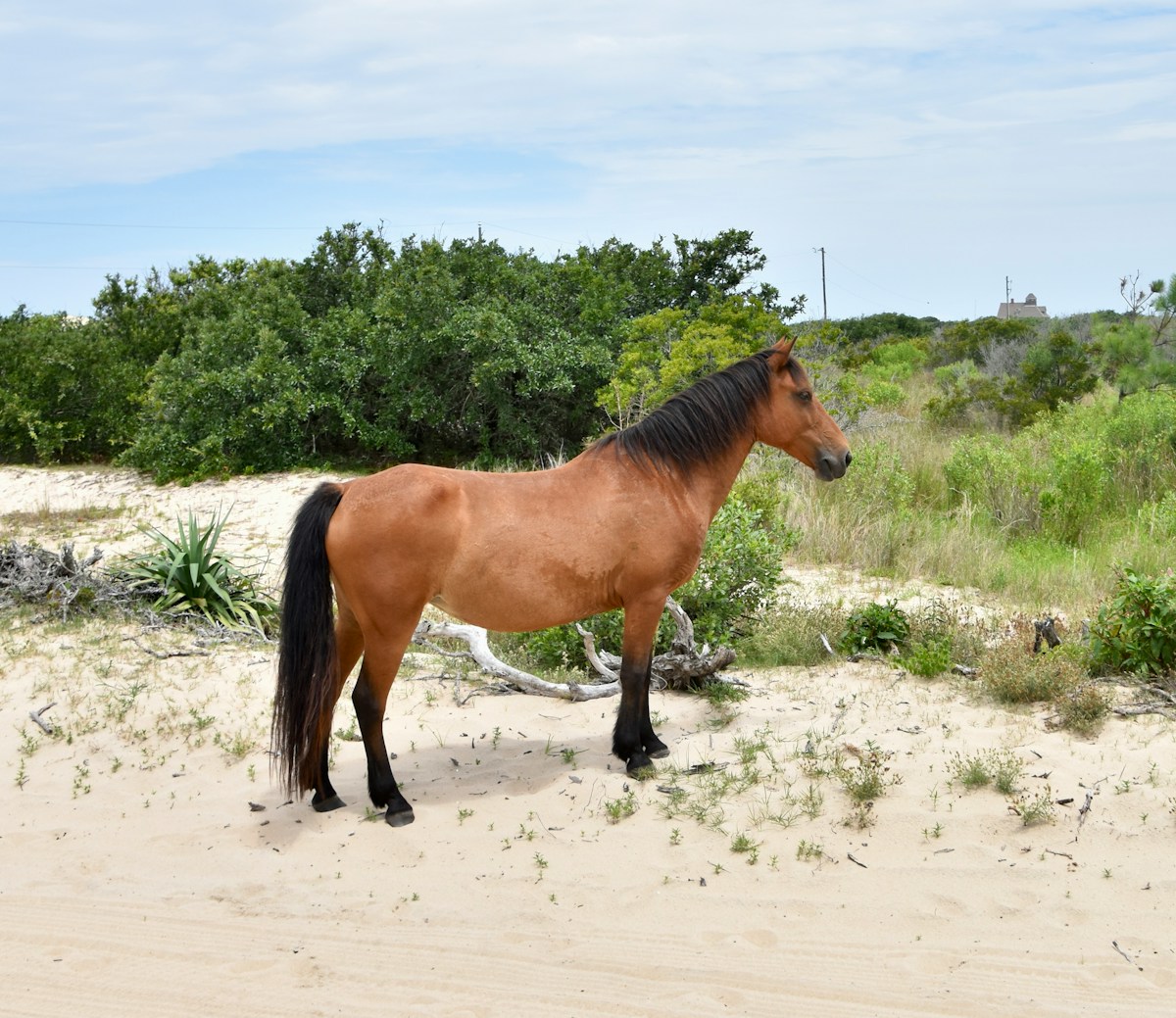
Roughly 100 feral Colonial Spanish Mustangs range the 4WD-accessible beach north of Corolla, where the paved road ends. The horses are descended from Spanish mustangs brought to the barrier islands by colonists in the 1500s; they have survived on the narrow island strip for over 400 years. Guided 4WD tours to find the herd run approximately $60–$80 per adult as of 2026 from operators in Corolla. Visitors with their own 4WD and the required beach driving permit (approximately $30 as of 2026, available at nps.gov/caha) can self-drive on the designated beach track. Federal law prohibits approaching within 50 feet of the horses; feeding them is illegal. The Corolla Wild Horse Museum on Corolla Village Road provides free context and history.
Ocracoke Island
Accessible only by ferry, Ocracoke is the most isolated permanently inhabited community in the Outer Banks. The village has roughly 900 residents, no traffic lights, no chain hotels, and a character unlike the resort areas to the north. The island’s main attraction is its beach: the Ocracoke Beach section of Cape Hatteras National Seashore is consistently rated among the finest undeveloped Atlantic beaches on the East Coast. The Silver Lake harbor area in the village holds a handful of restaurants, galleries, and inns concentrated on a one-mile stretch.
Ferries to Ocracoke run from Hatteras (free, approximately 60 minutes, runs continuously in season) and from Cedar Island and Swan Quarter on the mainland (approximately $15–$30 per vehicle as of 2026, approximately 2 hours, reservations required at ncferry.org). The pirate Edward Teach (“Blackbeard”) was killed in the inlet here in 1718.
Roanoke Island and Fort Raleigh
Roanoke Island in the sound between the Outer Banks and the mainland was the site of the first English settlement attempt in North America. The Lost Colony of 1587 - 117 settlers who disappeared without explanation before a resupply ship arrived in 1590 - remains one of American history’s most debated mysteries. Fort Raleigh National Historic Site tells the story; entry is free, and the reconstructed earthwork fort is on site. The Elizabethan Gardens adjacent to the site charge approximately $12 per adult as of 2026 and are maintained by the Garden Club of North Carolina.
Getting to the Outer Banks
By car: The primary access is via US 158 from the Elizabeth City area to the north (Kitty Hawk/Kill Devil Hills) or via US 64 over the Virginia Dare Memorial Bridge to Roanoke Island and then the Washington Baum Bridge to Nags Head. There is no bridge access south of Nags Head; reaching Hatteras Island requires driving south on Highway 12 through Cape Hatteras National Seashore. The nearest major airports are Norfolk International (ORF) in Virginia, approximately 80 miles north of Kitty Hawk, and Raleigh-Durham (RDU), approximately 180 miles west.
Ferry access: Hatteras to Ocracoke is free and reservations are not required. Cedar Island and Swan Quarter ferries to Ocracoke require advance booking, especially in summer.
Where to Stay
The Inn on Silver Lake (Ocracoke) - A 16-room inn in the village, on Silver Lake harbor. Rooms from approximately $180–$280 per night as of 2026. The closest the Outer Banks gets to boutique accommodation south of Duck.
Search hotels in Outer Banks on Booking.com
Sanderling Resort (Duck) - The most upscale property on the northern beaches, in the small community of Duck, with both ocean-front and sound-side access. Rooms from approximately $350–$600 per night as of 2026.
Sea Ranch Resort (Kill Devil Hills) - A mid-range oceanfront resort near the Wright Brothers memorial. Rooms from approximately $180–$320 per night as of 2026.
Vacation rental homes - The standard accommodation in the Outer Banks, particularly for families and groups. Several blocks of large rental homes (sleeping 8–16 people) are available in every Outer Banks community; weekly rentals during peak summer season typically run approximately $3,000–$8,000 depending on size and location, which can represent significant value per person compared to hotel rates.
Where to Eat
Sam & Omie’s (Nags Head) - A local institution open since 1937, serving breakfast from 7:00 am. The fisherman’s breakfast and crab eggs benedict are reliable. Breakfast plates approximately $12–$18 as of 2026.
Bad Bean Baja Grill (Kill Devil Hills) - Consistent fish tacos and burritos in a no-frills setting. Popular with locals year-round. Mains approximately $12–$20 as of 2026.
Outer Banks Brewing Station (Kill Devil Hills) - A brewpub built in a converted boathouse, with solid sandwiches and locally brewed beer. The only wind-powered commercial brewery in the US. Mains approximately $15–$28 as of 2026.
Jason’s Restaurant (Ocracoke) - Small, well-regarded seafood restaurant in the village. Local catch only; portions generous. Mains approximately $20–$38 as of 2026. The best sit-down option on the island.
Fish House Grill (Wanchese) - Working fishing village south of Manteo; the restaurant sells direct from the boats. Basic preparations of very fresh fish. Mains approximately $15–$28 as of 2026.
Best Time to Visit
June through August is high season - school holidays fill the rental houses, and US 158 becomes a near-daily traffic jam on summer Saturdays when weekly renters turn over. Water temperatures peak at 75–82°F.
May, September, and October are the preferred shoulder months - water still warm, crowds substantially reduced, prices 20–40% lower. September and October bring some of the best surf on the East Coast as offshore storms generate long-period swells. Hurricane risk peaks between mid-August and mid-October; check weather forecasts carefully for this window.
November through April is off-season, with many restaurants and some accommodations closed. The Outer Banks in winter is stark and beautiful - and virtually empty. Water temperatures drop to 45–55°F, making swimming impractical.
Practical Tips
- Highway 12 through Cape Hatteras National Seashore is subject to regular storm overwash closures, particularly in the stretch between Rodanthe and Salvo. Check current road conditions at ncdot.gov before driving south. The same road has been lost to beach erosion multiple times and is intermittently under threat.
- 4WD beach driving on Hatteras Island and north of Corolla requires deflating tires to approximately 20 psi. Rental 4WDs from Outer Banks operators come equipped with pumps; standard rental cars from airport agencies are prohibited on the beach.
- The Outer Banks has no public transit. A car is required for all travel.
- Fishing is deeply embedded in Outer Banks culture. Surf fishing (no license required for saltwater fishing in North Carolina), charter sportfishing from Oregon Inlet or Hatteras village, and clamming in the sounds are all accessible to visitors. Oregon Inlet Fishing Center maintains a fleet of charter boats.
- Thunderstorms on exposed beach with no shelter are a significant risk in summer. Leave the beach when a storm is visible within 10 miles - there is genuinely nowhere to take cover.
For guided boat trips, snorkelling excursions, and island experiences, browse tours and activities in the Outer Banks. Most visitors drive - from Raleigh allow around 3 hours, from Norfolk about 1.5 hours via US-158. Arrange travel insurance before departure.