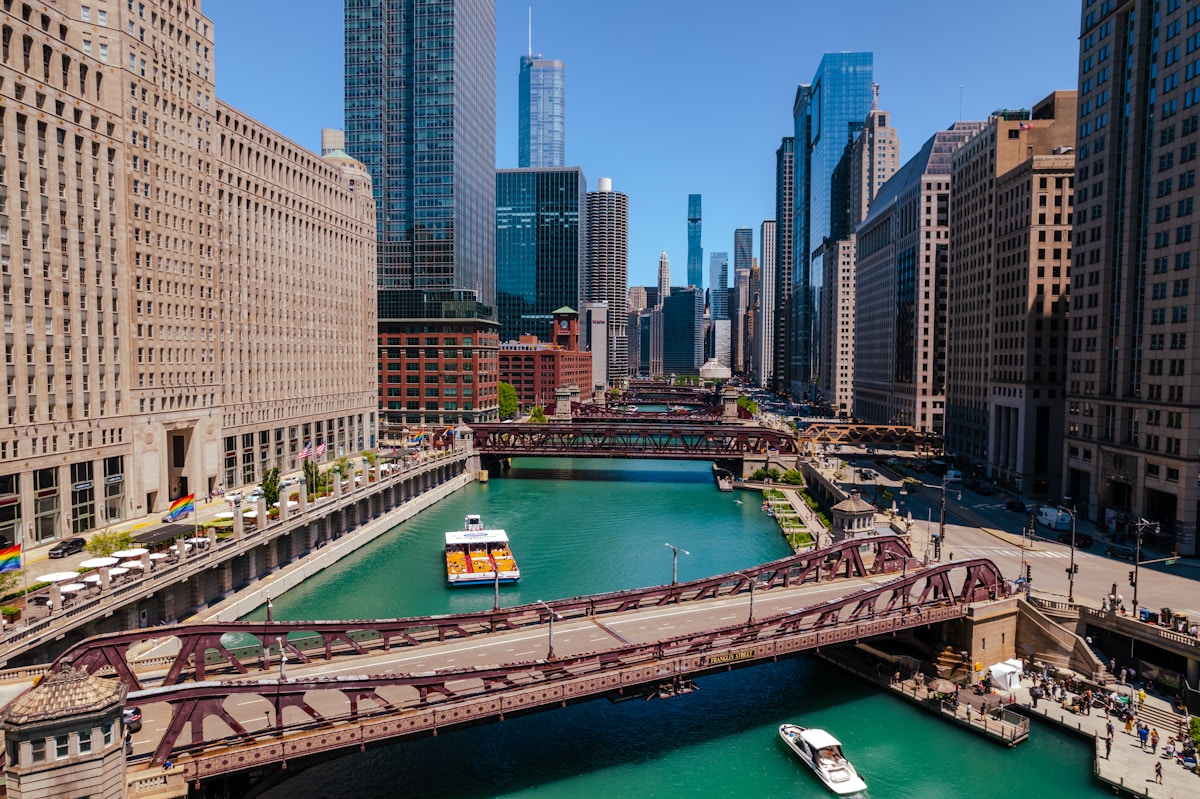
Chicago offers something few major US cities can match: world-class urban infrastructure at a cost that doesn’t require a seven-figure income to justify. The city’s 77 distinct neighborhoods each have a different character, the food scene is underrated nationally, and the Lake Michigan shoreline gives the city a visual quality that no inland city can match.
The winter is the honest caveat. December through February in Chicago is genuinely cold - temperatures regularly drop below 0°F (-18°C) with wind chill. Nomads who treat Chicago as a spring-through-fall base and relocate for the coldest months get the best version of the city.
Coworking Spaces
1871 (222 W Merchandise Mart Plaza, Fulton Market) is Chicago’s flagship startup and tech coworking hub. Community memberships start at approximately $200–$250/month, with access to events, mentorship programming, and one of the strongest startup networks in the Midwest. If you’re building something, this is the community to be in.
WeWork covers the Loop (300 S Riverside Plaza), River North (1 N Dearborn), and the West Loop (167 N Green St). Hot desks run approximately $300–$500/month as of 2026. The River North and West Loop locations tend to have better facilities than the Loop office.
Industrious Chicago (30 W Monroe St, Loop) offers premium dedicated desk options from approximately $500–$700/month. Conference rooms and phone booths are included, making it a strong choice for client-facing work.
The Dojo (1217 W Fullerton Ave, Lincoln Park / DePaul area) is a neighborhood-scale coworking option popular with freelancers and early-stage founders. Monthly memberships from approximately $150–$300/month - one of the better value options in the city.
Spaces by IWG has a River North location (321 N Clark St) with competitive pricing - hot desks from approximately $250–$400/month, often with new-member promotional rates.
For day passes, the Chicago Public Library system has solid wifi and quiet study space across dozens of branches - free and reliable for non-call work.
Best Cafes for Remote Work
Intelligentsia Coffee (53 E Randolph St in the Loop, and 3123 N Broadway in Lakeview) is the city’s benchmark specialty coffee shop, having originated in Chicago before expanding nationally. The Lakeview location is the most nomad-friendly - quieter, with better seating layout and fast wifi.
Sawada Coffee (112 N Green St, West Loop) is known for its military latte, but the wifi and seating make it a solid work session option on weekday mornings. Budget approximately $8–$14 per visit.
Hex Coffee (2412 N Milwaukee Ave, Logan Square) is one of the strongest options for Wicker Park / Logan Square nomads - strong wifi, no time limits enforced during weekday hours, and the neighborhood provides an easy escape to lunch options on Milwaukee Avenue.
Ipsento 606 (2035 N Western Ave, Bucktown) sits near the 606 Trail - combine a morning run along the elevated trail with a work session. Fast wifi and a neighborhood community feel.
Gaslight Coffee Roasters (2385 N Milwaukee Ave, Logan Square) is a Logan Square fixture with reliable internet and plenty of space for laptop work. Evenings get busy; mornings are ideal.
Average Rent (1-Bedroom)
Chicago rents are substantially lower than coastal metros. As of 2026:
- Wicker Park / Bucktown: approximately $1,700–$2,200/month
- Logan Square: approximately $1,500–$2,000/month
- River North / Old Town: approximately $2,000–$2,800/month
- The Loop / South Loop: approximately $1,800–$2,500/month
- Pilsen / Bridgeport: approximately $1,200–$1,700/month
- Hyde Park: approximately $1,300–$1,800/month
Pilsen offers the best value for nomads who need a quiet, affordable base and don’t mind being further from the northwest-side cafe scene. Wicker Park remains the best all-round choice for lifestyle and practicality.
Cost of Living Breakdown (Monthly Estimate)
| Category | Approximate Monthly Cost |
|---|---|
| 1-bed rent (Wicker Park) | $1,700–$2,200 |
| Groceries | $350–$500 |
| Eating out (3–4x/week) | $300–$550 |
| Coworking (hot desk) | $200–$450 |
| CTA transit pass (unlimited) | $105 |
| Utilities + internet | $130–$200 |
| Total estimate | $2,785–$4,005 |
Chicago’s transit network (the CTA “L” train and bus system) is genuinely functional - unlike many US cities, you can live well in Chicago without a car if you pick a transit-connected neighborhood.
Internet Quality
Home internet via Comcast Xfinity, AT&T Fiber, and RCN covers most Chicago neighborhoods. AT&T Fiber is the most consistent at 1Gbps plans for approximately $55–$80/month. 5G coverage from Verizon and T-Mobile is strong across the city and suburbs. Coworking spaces offer gigabit connections. Cafe wifi quality is generally good in Wicker Park, Logan Square, and the West Loop - run Fast.com before video calls.
Visa and Entry
US citizens require no visa. Illinois has a flat 4.95% income tax rate - lower than California but higher than Texas and Florida. Chicago also levies a city income tax at 2.25% for residents. Foreign nationals on B1/B2 visas cannot legally work for US clients.
Best Neighborhoods for Nomads
Wicker Park is the top overall pick - the intersection of Milwaukee, North, and Damen avenues (the “six corners”) anchors a walkable neighborhood with cafes, restaurants, and transit access to the Blue Line. Rents have increased in recent years but remain below comparable neighborhoods in NYC or San Francisco.
Logan Square is the value-for-money alternative - slightly further out on the Blue Line, with lower rents and an increasingly strong food and coffee scene along Milwaukee Avenue and Logan Boulevard. The neighborhood has a creative, community-oriented feel.
The West Loop suits nomads who want to be close to the tech and startup scene - 1871 is here, several coworking spaces are within walking distance, and the restaurant corridor along Randolph Street is the best dining strip in the city.
River North works for nomads who need central access and client proximity - expensive relative to other Chicago neighborhoods, but well-connected and walkable.
Best Time to Visit
May, June, September, and October are the optimal months - mild temperatures (60–80°F / 15–27°C), lower humidity than July and August, and the lakefront is genuinely beautiful. July and August are peak tourist season with warm weather and outdoor events but crowded. March and April are variable. November through February is the full winter season - plan accordingly.
City Guides
Search hotels in United States on Booking.com
Stay connected with an eSIM for the USA - essential for working from parks along the 606 Trail and the lakefront. Compare flights to Chicago and arrange travel insurance that covers extended stays.