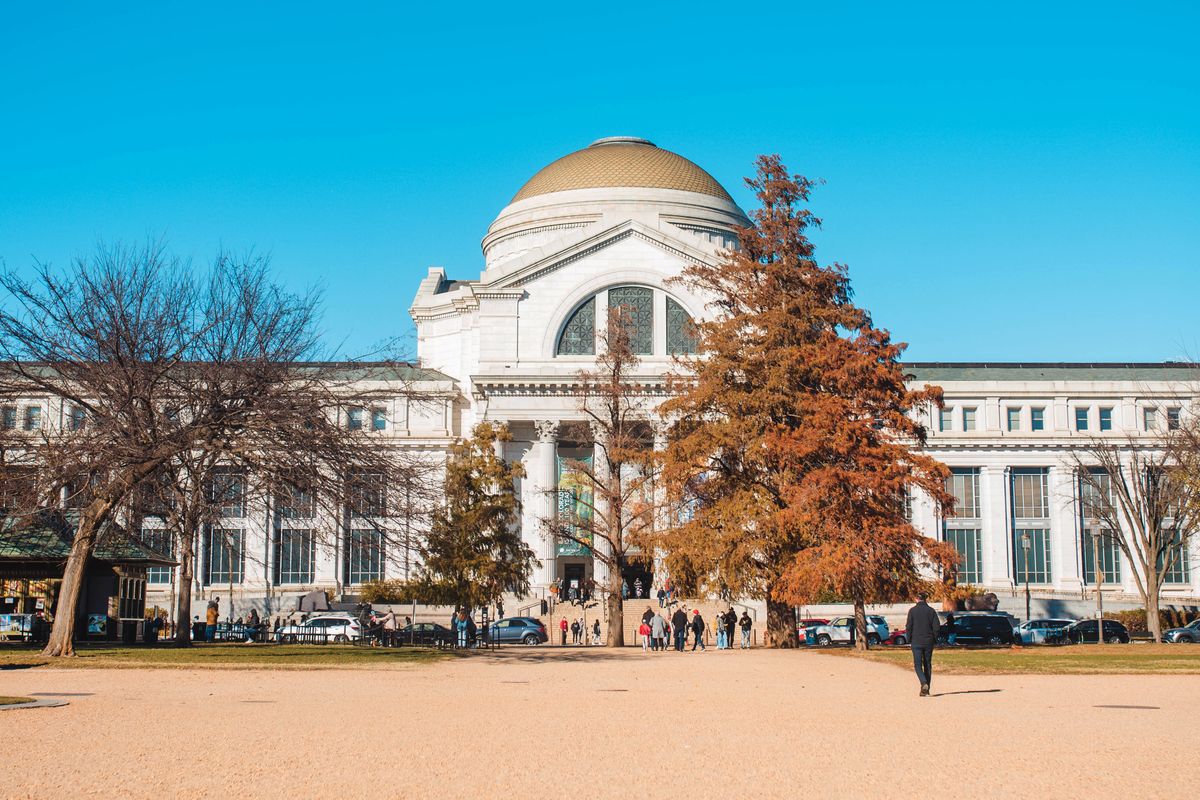
The National Museum of Natural History is one of the world’s great natural history institutions and, by visitor numbers, one of the most visited museums on earth. It holds more than 146 million specimens across its collections - from the 45.52-carat Hope Diamond to the first mounted Triceratops skeleton ever displayed publicly. Entry is free every day of the year with no reservation required.
Entry, Tickets, and Hours
Admission to the National Museum of Natural History is free. There are no tickets, no booking system, and no timed-entry requirement under normal operating conditions. Walk up to any of the ground-floor entrances on the National Mall side (Constitution Avenue NW) or the Madison Drive side and enter directly.
The museum is open daily 10am to 5:30pm, including weekends and most federal holidays. It closes only on Christmas Day. During peak summer season (late June through August), hours sometimes extend to 7:30pm - check the Smithsonian website (si.edu) for the current schedule before visiting.
Note: The National Museum of African American History and Culture (NMAAHC), a separate Smithsonian institution a few blocks away, does require free advance timed-entry passes from recreation.gov. The Natural History Museum is not subject to that system.
What to See: The Key Collections
The Rotunda and African Elephant
The main entrance leads into a circular ground-floor rotunda dominated by a mounted African bush elephant - the largest land animal specimen on display in any museum. The elephant has been the centrepiece of the rotunda since 1959. It was collected in Angola in 1955 and stands 13 feet (4 metres) at the shoulder. Everything branches outward from this central space.
The Hope Diamond
Located on the second floor in the Janet Annenberg Hooker Hall of Geology, Gems, and Minerals, the Hope Diamond is the most-visited object in the building. The 45.52-carat blue diamond arrived at the Smithsonian in 1958, donated by jeweller Harry Winston, who shipped it by regular post. It has been here ever since. The stone’s deep steel-blue colour comes from trace amounts of boron; when exposed to ultraviolet light, it glows an eerie red for several seconds. The gem and mineral hall surrounding it is itself remarkable - a 15-foot meteorite, a 910-carat blue topaz, and cabinets of crystals from every major deposit on Earth.
Dinosaur Halls: Nation’s T. rex
The David H. Koch Hall of Fossils - Deep Time reopened in 2019 after a five-year closure. The centrepiece is “the Nation’s T. rex,” a Tyrannosaurus rex excavated in Montana, one of the most complete specimens in existence. The hall arranges fossils chronologically from the origins of life through the Cretaceous mass extinction, with each section explaining the environmental conditions that drove evolution. Allow at least 45 minutes here. The hall also holds the first Triceratops skeleton ever mounted for public display, acquired in 1905.
Human Origins
The David H. Koch Hall of Human Origins on the ground floor traces 6 million years of human evolution through fossil skulls, reconstructed Neanderthal and Homo sapiens figures, and interactive climate-change simulations. The exhibit makes a case for how environmental pressure shaped human anatomy and behaviour over deep time. It is one of the most scientifically rigorous exhibits in the building - the Smithsonian’s human evolution research team contributes directly to its content.
Ocean Hall and Live Coral
The Sant Ocean Hall on the second floor is the largest hall in the museum. A suspended model of a 45-foot North Atlantic right whale dominates the ceiling. The hall covers ocean ecosystems from the deep sea to coral reefs, with live coral tanks that are among the few in any natural history museum. The fossil collection includes a giant Megalodon jaw reconstruction and a 15-foot-long mosasaur skeleton.
Butterflies and Beyond: The Live Butterfly Pavilion
The Butterfly Pavilion runs seasonally (typically February through late May) as a paid add-on: approximately $8 adult, $6 child (as of 2026). Visitors walk through a tropical enclosure where live butterflies land on arms and shoulders. It is the only paid component in the building. Check the museum website for the current season dates.
Practical Tips
Getting there: The Smithsonian Metro station (Blue, Orange, Silver Lines) puts you one block south of the museum. Federal Triangle station is a short walk to the northwest. There is no public parking immediately adjacent; the city’s parking garage network is available nearby but expensive. Most visitors arrive by Metro.
Food: The ground-floor café offers sandwiches, salads, and hot food at prices typical of museum dining (approximately $12–18 per meal). A rooftop café operates seasonally. The National Mall is 300 metres away if you prefer to bring your own food and eat outside.
Crowds: The museum sees its heaviest visitor numbers on school-trip days (weekdays March–June) and summer weekends. Arriving at 10am when doors open, or after 3pm when day-trippers start to leave, gives a markedly less crowded experience. The Hope Diamond display is consistently the most congested point in the building.
Accessibility: The building is fully wheelchair accessible via ramps and lifts. All permanent exhibition floors are reachable without stairs.
Combining with Other Smithsonian Museums
The National Museum of Natural History shares the National Mall with several other Smithsonian institutions, all free:
- National Museum of American History (two blocks west): the Star-Spangled Banner flag, Julia Child’s kitchen, and the First Ladies’ gown collection.
- National Air and Space Museum (four blocks east): the Wright Brothers’ Flyer, Apollo 11 capsule, and Charles Lindbergh’s Spirit of St. Louis - all original objects.
- Hirshhorn Museum (adjacent): the Smithsonian’s modern and contemporary art collection.
A single day is enough to cover Natural History thoroughly. Adding a second Smithsonian museum to the same day works best if you prioritise American History or Air and Space, both of which are direct walking distance.
For guided context and the history behind the Mall’s layout, see our Washington DC attractions overview. For accommodation choices near the Mall, our Washington DC hotels guide covers options from Capitol Hill to Georgetown across all price ranges.