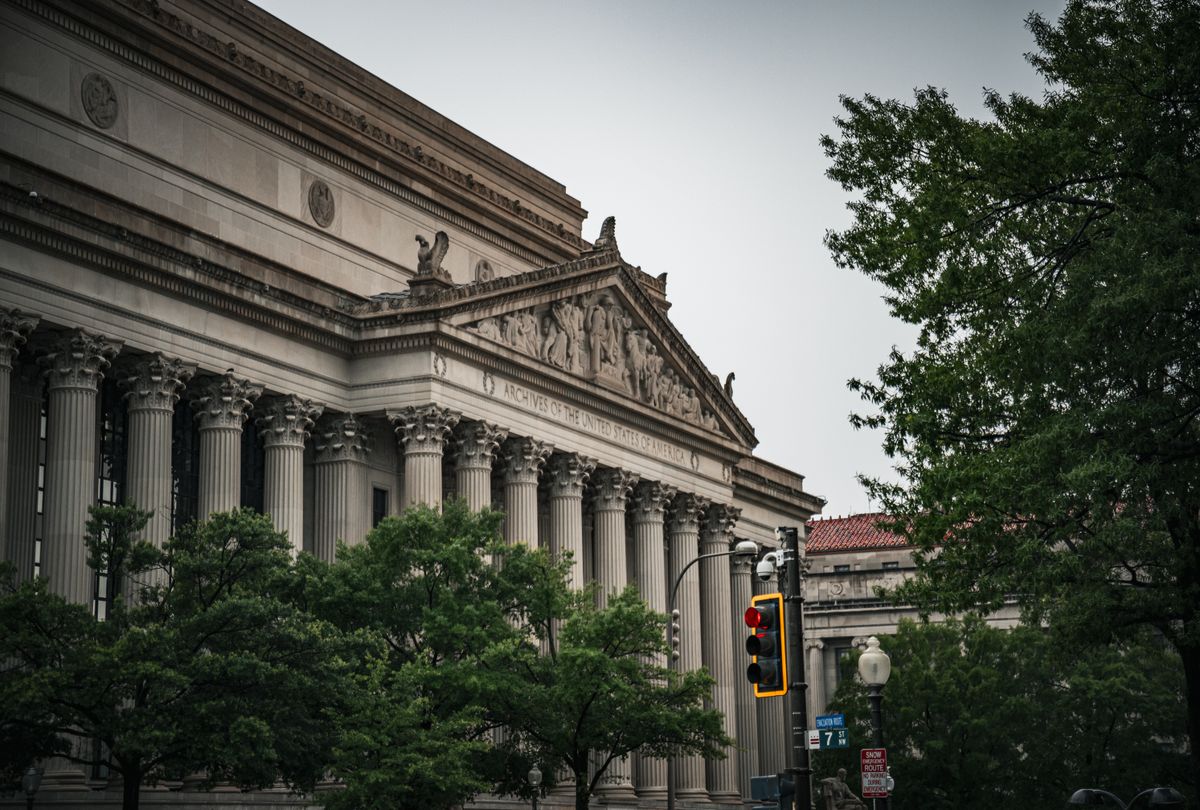
The National Archives Building on Constitution Avenue holds the most consequential documents in American history. The Declaration of Independence, the Constitution of the United States, and the Bill of Rights - collectively the Charters of Freedom - are on permanent display in the Rotunda on the upper level, viewable by any visitor at no cost. The building itself is a neoclassical monument designed by John Russell Pope, completed in 1935, with a 75-foot bronze door at the Pennsylvania Avenue entrance and inscriptions reading “What Is Past Is Prologue” on the south exterior.
Entry, Tickets, and Hours
Admission to the National Archives Museum is free. No tickets are sold and no payment is required. For the Rotunda specifically, free timed-entry passes are recommended during the March-through-August peak season and on school-group weekdays. Reserve them at archives.gov at no charge.
Walk-in Rotunda access is available when daily capacity allows. In the October through February off-season, walk-in visitors rarely wait more than 10–15 minutes. During summer peak season and on Washington’s busiest school-trip days (typically mid-March through May), reserved passes eliminate waiting.
Hours: Wednesday through Sunday, 10am to 5:30pm. The museum is closed Monday and Tuesday, Thanksgiving, and Christmas Day. The Research Center maintains separate hours for registered researchers.
The Rotunda: The Charters of Freedom
The Rotunda for the Charters of Freedom sits on the upper level of the building. The space is deliberately ceremonial - a 75-foot-high domed hall with murals by Barry Faulkner depicting the presentation of the Declaration of Independence and the Constitution. The documents sit in cases at floor level, lowered into a vault 22 feet underground each night and raised again at opening.
The Declaration of Independence
The Declaration was signed by 56 delegates between August 2 and November 1776 (not July 4, as commonly assumed - that date marks when the Continental Congress voted to adopt the document). The parchment on display is the engrossed copy, produced by Timothy Matlack. The ink has faded considerably since 1776 - the document was damaged in the nineteenth century by early photographic reproduction processes that required direct light exposure - but the signatures and main text remain readable. The most prominent signature, John Hancock’s, appears in the centre-right of the signature block.
The Constitution
The Constitution of the United States is displayed across four parchment pages. The document was finalised on September 17, 1787, by the Constitutional Convention in Philadelphia, and ratified by nine states the following year. The original document shows handwritten corrections and insertions made during the drafting process. The signatures of 39 of the 55 delegates appear on the fourth page, including George Washington, Benjamin Franklin, James Madison, and Alexander Hamilton.
The Bill of Rights
The twelve proposed amendments that Congress sent to the states in 1789 are displayed in the third case. Ten were ratified by December 1791 and became the Bill of Rights. The two that were not ratified - concerning congressional apportionment and congressional pay - are visible in the original document. The Congressional Apportionment Amendment was never ratified; the Pay Amendment became the 27th Amendment in 1992, more than 200 years later.
The Public Vaults
The Public Vaults gallery adjacent to the Rotunda is the most substantial exhibition in the building and one of the most undervisited major exhibitions in Washington DC. It occupies a large permanent space designed to evoke the actual stacks and vaults of the Archives.
The exhibition is organised thematically: war and military service records (including original discharge papers from the Civil War and World War II), immigration records (including Ellis Island arrival documents and passenger manifests), civil rights records (affidavits, court orders, FBI surveillance files), presidential records (Nixon White House tapes are referenced and excerpted), and census records tracing family histories across generations.
Individual drawers and cases throughout the exhibition contain actual government documents - not reproductions - that visitors can examine. The Nixon impeachment materials, with original Committee on the Judiciary documentation, are among the most examined. The Watergate tapes transcription materials are displayed with the original typed text and handwritten corrections.
Allow at least 45 minutes in the Public Vaults on top of time in the Rotunda. Together they make a 1.5–2 hour visit at a measured pace.
Records of Rights
This permanent gallery covers the history of civil liberties, citizenship, and legal recognition in the United States. Documents include early naturalization records, Freedmen’s Bureau records from the post-Civil War period, women’s suffrage petitions, Japanese American internment orders and resisters’ legal filings, and civil rights movement affidavits from the 1950s and 1960s. The exhibition is more textually dense than the Public Vaults but rewards careful reading.
Genealogy Research at the National Archives
The National Archives holds the most extensive collection of American genealogical records in existence: census records, military service records, immigration and naturalization records, land records, and court records covering the full span of US history. The Washington DC Research Center on the ground floor is open to the public (free, registration required) for direct examination of records. Researchers must book appointments in advance at archives.gov.
For genealogy visitors, the National Archives in College Park, Maryland (Archives II) holds mid-twentieth century records and is a separate facility; plan accordingly if your research extends into the post-1950 period.
Getting There
The National Archives is at 700 Pennsylvania Avenue NW, between 7th and 9th Streets. The Pennsylvania Avenue NW entrance (the primary public entrance) faces the Federal Triangle. The Constitution Avenue NW entrance serves visitors arriving from the National Mall side.
Metro: Archives-Navy Memorial-Penn Quarter station (Green and Yellow Lines) is one block north. The gallery exit from the station puts you directly on 7th Street, one block from the Archives’ Pennsylvania Avenue entrance. Judiciary Square station (Red Line) is a 5-minute walk.
Combining with Nearby Attractions
The National Archives sits in the cluster between the National Mall and Penn Quarter - within 10–15 minutes’ walk of several major sites:
- National Gallery of Art (one block east on the Mall): the East Building holds modern and contemporary art; the West Building covers European masters from medieval through early twentieth century. Both are free.
- International Spy Museum (five blocks south at L’Enfant Plaza): the city’s best paid attraction, $25.95 adult - see our International Spy Museum guide.
- US Capitol (10 minutes east): free tours require advance reservation through the Capitol Visitor Center. The Library of Congress is directly adjacent.
For a full overview of what’s worth seeing and what to prioritise by day, see our Washington DC attractions guide. For hotels in the Penn Quarter and Capitol Hill area, our DC hotels guide covers the closest options to the Archives.
DC Free Historic Sites at a Glance
All of the following are free to enter. Timed passes are required for two of them in peak season. Book Washington DC history tours on GetYourGuide.
| Site | Cost | Advance Pass? | Duration |
|---|---|---|---|
| National Archives (Rotunda) | Free | Recommended Mar–Aug (archives.gov) | 1.5–2 hrs |
| National Gallery of Art | Free | No | 2–3 hrs |
| US Capitol Tour | Free | Yes - book via visitthecapitol.gov | 1 hr |
| Library of Congress (reading rooms) | Free | No | 45 min |
| Washington Monument (observation deck) | Free | Yes - recreation.gov, 30 days ahead | 45 min–1 hr |
| DC History Walking Tour (guided) | ~$25 | No | 2–3 hrs - Book on GYG |