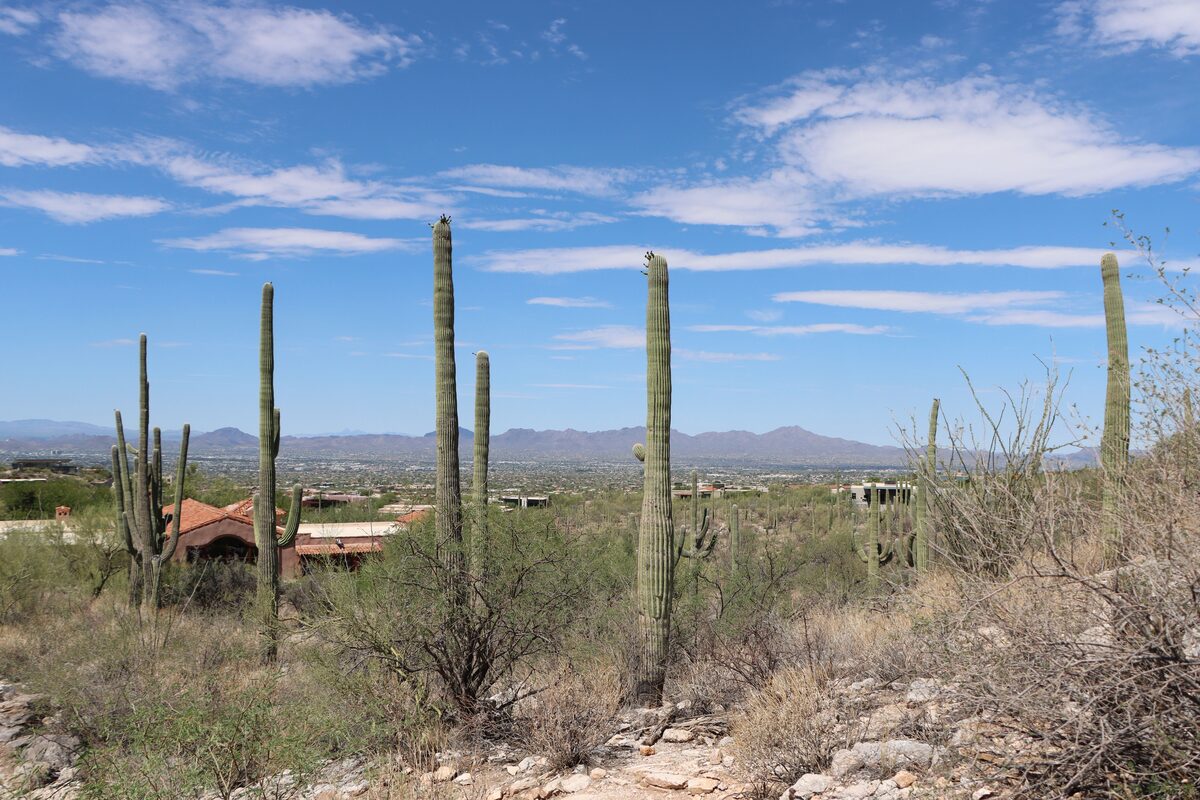
Tucson is surrounded on four sides by mountain ranges - the Santa Catalinas to the north, the Rincons to the east, the Tucson Mountains to the west, and the Santa Ritas to the south - and the city essentially sits inside Saguaro National Park, split into two districts. This geography makes outdoor activity the default mode of visiting, but the city’s borderlands culture (shaped by O’odham, Spanish colonial, and Mexican influence over centuries) and its UNESCO City of Gastronomy designation mean there is substance indoors too.
Saguaro National Park
The giant saguaro cactus grows only in the Sonoran Desert, and Tucson is the only American city with a national park split around it. The two districts are distinct enough to justify visiting both.
Rincon Mountain District (East) - 3693 S. Old Spanish Trail. The larger district, with the 8-mile paved Cactus Forest Loop Drive accessible to all vehicles and a network of backcountry trails leading into the Rincon Mountains. The Mica View picnic area has good saguaro density; the Freeman Homestead Trail (1.6 miles round trip) is one of the most accessible walking routes in the park. The backcountry campsites in the Rincons require advance permits. Entry approximately $25 per vehicle.
Tucson Mountain District (West) - 2700 N. Kinney Rd. Denser saguaro forest and lower elevation than the east district. The Bajada Loop Drive (6-mile unpaved loop, suitable for passenger cars in dry conditions) passes Signal Hill, where a short walk from the parking area reaches a concentration of Hohokam petroglyphs (prehistoric rock carvings). The district is immediately adjacent to the Arizona-Sonora Desert Museum - most visitors combine the two.
Both districts are open daily, year-round. The America the Beautiful annual pass ($80 per vehicle, covers all US national parks and federal recreation areas) is worth buying if you’re visiting more than two national parks in a year.
Arizona-Sonora Desert Museum
2021 N. Kinney Rd, Tucson Mountain District. One of the most compelling natural history museums in the United States - not despite being outdoors, but because of it. The 98-acre site combines a world-class botanical garden (1,200+ desert plant species) with living animals housed in naturalistic desert habitats and a geology gallery embedded in an actual desert hillside.
The animals include mountain lions, Mexican wolves, javelinas, bobcats, black bears, river otters, and a large raptor aviary. Two free-flight raptor demonstrations run daily at 10am and 2pm (times vary seasonally). The hummingbird aviary - a walk-through enclosure where hummingbirds fly around visitors - is one of the most unusual experiences in Tucson.
Admission approximately $25 adults, $10 children (ages 3–12) as of 2026. Open daily; hours vary by season (typically 7:30am–5pm in summer, 8:30am–5pm in winter). Allow 3–4 hours minimum. A café on-site serves lunch.
Mission San Xavier del Bac
1950 W. San Xavier Rd, Tohono O’odham San Xavier District, approximately 9 miles south of downtown. A functioning Catholic mission church constructed between 1783 and 1797 in the Spanish Baroque style - towers, arched doorways, and whitewashed plaster that earned it the local name “the White Dove of the Desert.” The interior murals and carved altarpiece are original 18th-century work and are among the finest surviving examples of colonial religious art in the American Southwest.
The church is both a National Historic Landmark and an active parish for the Tohono O’odham community. Visitors are welcome during daylight hours; dress modestly (shoulders covered). Free admission; donations requested. The hill behind the church has a small shrine and good views of the Santa Cruz River valley.
| Tour | Duration | From | Book |
|---|---|---|---|
| Downtown Tucson & El Presidio Walking Tour | 2 hrs | $35 | Book |
| Guided Horseback Ride in the Sonoran Desert | 1 hr | $78 | Book |
| Tucson Food Tour: 6 Southwestern Tastings | 3 hrs | $87 | Book |
| Kitt Peak Dark Sky Discovery Night Program | 4.5 hrs | $109 | Book |
Browse all Tucson tours and activities on GetYourGuide - free cancellation on most bookings up to 24 hours before departure.
Mount Lemmon and the Santa Catalina Mountains
The Catalina Highway (Sky Island Scenic Byway) begins on the northeast edge of Tucson at Tanque Verde Road and climbs 25 miles to the summit of Mount Lemmon at 9,157 feet, passing through seven distinct ecological zones - from Sonoran Desert through grassland, oak woodland, and pine forest. The drive takes approximately 45–60 minutes one way.
Key stops on the Catalina Highway:
- Windy Point Vista (approximately mile 14) - the most dramatic viewpoint, with sheer rock faces and expansive views back over Tucson and the desert floor
- Geology Vista - interpretive panels explaining the exposed granite and quartzite formations that make up the Santa Catalinas
- Summerhaven (summit) - a small mountain village with the Mount Lemmon Cookie Cabin (baked goods and limited meals), a general store, and access to hiking trails
- Mount Lemmon Ski Valley - the southernmost ski resort in the continental United States; open December through March depending on snowfall; lift tickets approximately $20–35; ski and snowboard rentals available
In summer, temperatures at the summit run approximately 30°F cooler than Tucson below - a useful fact when city temperatures exceed 100°F in July and August.
Biosphere 2
32540 S. Biosphere Rd, Oracle (approximately 35 miles north of Tucson via US-77 and AZ-79). The University of Arizona research facility became famous when scientists sealed themselves inside its five-biome glass enclosure for two years (1991–1993) in an attempt at closed ecological self-sufficiency. The facility is now a legitimate research station studying climate and ecosystem science, and guided tours take visitors through the original biomes: tropical rainforest, ocean, savanna, mangrove, and desert, plus the basement “technosphere” of pipes and machinery.
Tours approximately $25 adults, $18 children (ages 6–12), approximately 1.5 hours as of 2026. Book in advance; tours depart hourly 9am–4pm. The ocean biome (a 700,000-gallon saltwater tank now used for ocean acidification research) and the rainforest are the most impressive spaces. Open daily.
Downtown Tucson and 4th Avenue
Hotel Congress and downtown Congress Street - the 1919 Hotel Congress (311 E. Congress St) is the cultural anchor of downtown. It was here that FBI agents captured Depression-era gangster John Dillinger in January 1934, and the hotel has leaned into its history without becoming a caricature. The Cup Café in the hotel lobby is a reliable breakfast and lunch spot; the Club Congress hosts live music most weekends; the tap room has maintained a lively bar scene since before Tucson’s downtown revival.
The Congress Street corridor between 4th and 6th Avenues has a concentration of galleries, clothing shops, and bars. The Hotel Congress is walking distance from the Rialto Theatre (318 E. Congress St, a 1920 vaudeville house now booking national touring acts) and the Fox Tucson Theatre (17 W. Congress St, a 1930 atmospheric movie palace restored to its original condition).
4th Avenue - the half-mile strip of independent shops, vintage stores, cafés, and restaurants connecting downtown to the University of Arizona district. The 4th Avenue Street Fair (held in late November/early December and again in March) is one of the largest outdoor street fairs in Arizona, drawing over 300 vendors.
Mercado San Agustín - 100 S. Avenida del Convento, near the Santa Cruz River greenway. A marketplace anchored by a taqueria courtyard, coffee roasters, and small food businesses in a restored 1930s building. More neighborhood than tourist destination; the breakfast and lunch crowds are mostly local.
Day Trips from Tucson
Tumacácori National Historical Park - approximately 45 miles south via I-19. The ruins of three 18th-century Spanish colonial missions, of which the Tumacácori church is the most intact. A companion to Mission San Xavier, it offers a different scale and a more atmospheric ruin feel. Entry approximately $10 per vehicle; free with America the Beautiful pass. Tubac, just north, has become Arizona’s largest arts community.
Tombstone - approximately 70 miles southeast via I-10 and AZ-80. The 1880s silver-mining boomtown where the Gunfight at the O.K. Corral took place on October 26, 1881. The historic district has preserved its original Victorian streetscape better than most Western towns; the gunfight is reenacted daily at approximately $10 per person. More authentically historical than its reputation suggests.
Kartchner Caverns State Park - approximately 50 miles east via I-10 and AZ-90. Living limestone caves discovered in 1974 and opened to the public in 1999. Two tour options: the Rotunda/Throne Room tour (features a 58-foot stalactite, Arizona’s longest) and the Big Room tour (open October–April only, when the bat colony is absent). Reservations strongly recommended; tours approximately $23 adults, $13 children (ages 7–13) as of 2026.