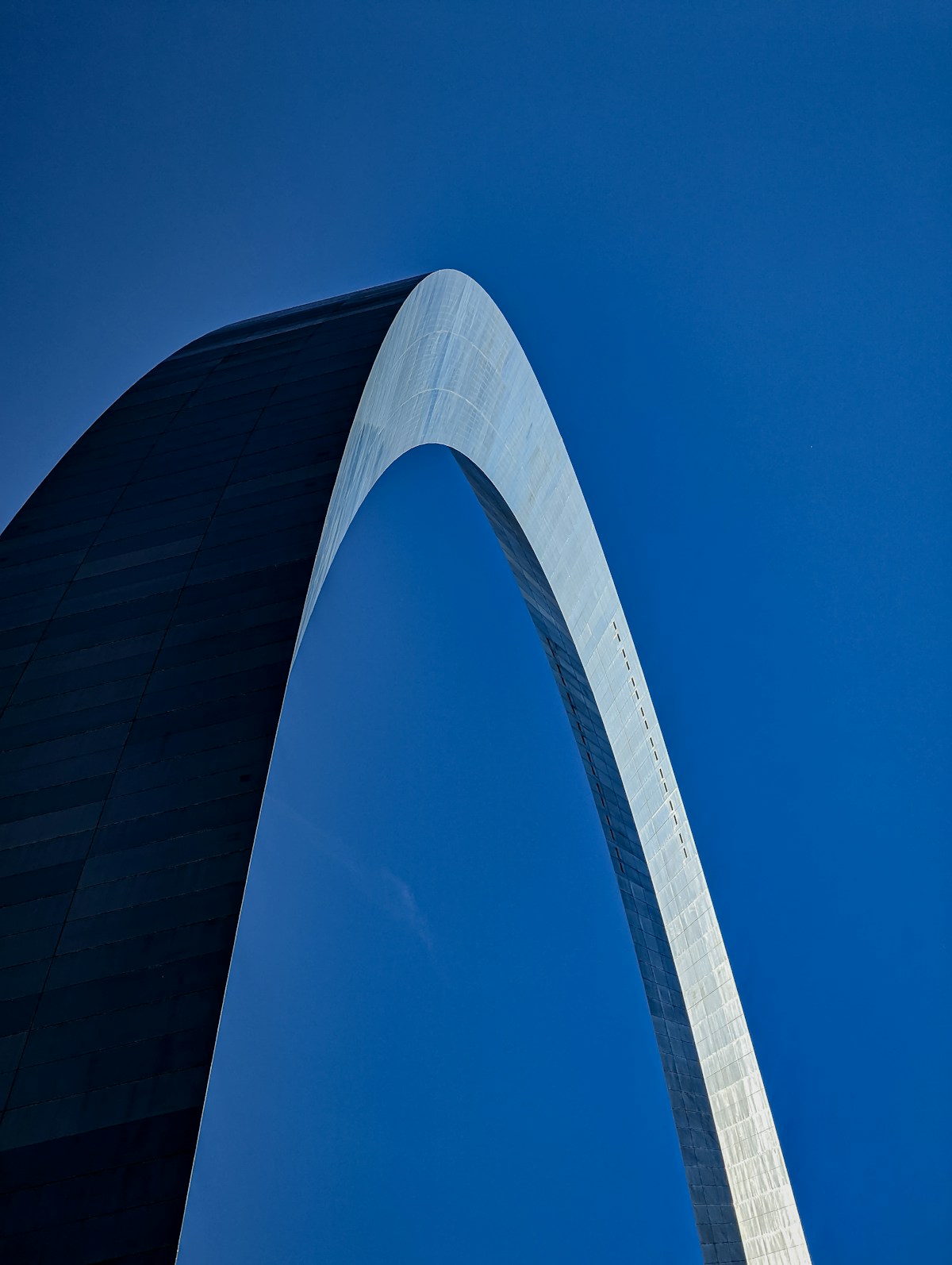
St. Louis has a practical advantage for visitors that few comparable US cities match: most of its major cultural institutions are free. The St. Louis Art Museum, the Missouri History Museum, the St. Louis Zoo, and Forest Park itself require no admission fee. This, combined with the Gateway Arch’s status as an architectural landmark of genuine international significance, makes St. Louis one of the most underrated American city destinations.
Gateway Arch National Park
The Gateway Arch (11 N 4th St) is a 630-foot stainless steel catenary arch on the west bank of the Mississippi River, designed by Eero Saarinen and completed in 1965. It is the tallest man-made monument in the United States and among the most significant works of 20th-century architecture in the country. The mathematical precision of the design - the arch is exactly as wide as it is tall - is more apparent in person than in photographs.
The tram system inside the arch legs carries passengers to the observation window at the top in small egg-shaped pods (5 passengers per pod, 4-minute ride each way). The observation windows provide views across the Mississippi into Illinois and west over the city. Tram admission approximately $15 for adults as of 2026. Book via gatewayarch.com - summer weekends sell out early; mid-week and morning slots are more available.
The Museum at the Gateway Arch beneath the monument covers westward expansion history with primary source materials, artefacts from the Lewis and Clark expedition, and a thorough account of Indigenous displacement. Free to enter. Open daily 9am–6pm; extended hours in summer.
Forest Park
Forest Park (290 acres larger than New York’s Central Park) was the site of the 1904 World’s Fair and contains several of the city’s most important institutions, all free or low-cost.
St. Louis Art Museum (1 Fine Arts Dr): Free admission to the permanent collection. The collection of approximately 33,000 works is particularly strong in German Expressionism (one of the largest collections outside Germany), pre-Columbian works, ancient Mediterranean, and American 19th- and 20th-century painting. Special exhibitions run approximately $12–$20. Open Tuesday–Sunday 10am–5pm; Friday until 9pm.
Missouri History Museum (Lindell Blvd at DeBaliviere): Covers St. Louis and Missouri history from French colonial settlement through the present. Permanent collection free; special exhibitions approximately $8–$14. Open Tuesday–Sunday 10am–5pm; Tuesday until 8pm.
St. Louis Zoo (1 Government Dr): General admission free (some premium exhibits approximately $4–$6). One of the top-rated zoos in the United States for collection size and animal welfare standards. The Penguin and Puffin Coast and the Living World insectarium are the most frequently cited exhibits. Open daily 9am–5pm; until 7pm summer weekdays.
The Jewel Box (McKinley Dr, Forest Park): A 1936 Art Deco glass greenhouse hosting seasonal flower shows. Free admission; seasonal exhibitions approximately $2–$3.
Missouri Botanical Garden
The Missouri Botanical Garden (4344 Shaw Blvd) is a 79-acre research garden and public park founded in 1859 by Henry Shaw - one of the oldest continuously operating botanical gardens in the US. The Climatron (1960) is a geodesic dome housing a tropical rainforest with over 2,800 plant species. The Kemper Center for Home Gardening and the Seiwa-en Japanese Garden (14 acres, one of the largest Japanese gardens in North America) are both open with the general admission ticket.
Admission approximately $15 for adults; children under 12 free as of 2026. Open daily 9am–5pm; summer Wednesdays until 8pm. The garden is approximately 3 miles from downtown - hire a car to reach it comfortably; parking available on-site.
Busch Stadium and Cardinals Baseball
Busch Stadium (700 Clark Ave) opened in 2006 and was designed to frame views of the Gateway Arch from within the seating bowl. The Cardinals have won 11 World Series titles - the most in the National League - and their games are attended with a loyalty and knowledge unusual even for baseball. The stadium holds approximately 44,000 and regularly fills.
General admission tickets from approximately $15 for upper-level seats; field-level seats from approximately $65 as of 2026. The Cardinals Hall of Fame and Museum inside the stadium (admission approximately $12) can be visited without a game ticket. The stadium is walkable from most downtown hotels and accessible via MetroLink’s Civic Center station (0.5 miles).
Search hotels in St Louis on Booking.com
Soulard and the Blues
Soulard (bounded roughly by I-55, the river, and Chouteau Ave) is St. Louis’s oldest residential neighbourhood - French Creole rowhouses from the early 19th century preserved in a near-continuous streetscape that makes it the most architecturally consistent historic neighbourhood in the city.
Soulard Market (730 Carroll St): A public market in operation since 1779 (the current building from 1929), open Wednesday–Sunday. Fresh produce, meat, specialty food, and a Saturday market that draws 10,000+ visitors. Free to enter.
Hammerstone’s (2028 S 9th St): The anchor live music venue in Soulard, hosting blues nightly. No cover most evenings; occasionally $5–$10 for featured acts. Open daily from 11am.
Broadway Oyster Bar (736 S Broadway): Live music 7 nights a week in a converted building with an outdoor patio. The crawfish and oysters are the food draws; the music is blues, jazz, and zydeco. Open daily from 11am.
The Loop
The Delmar Loop (6200–6600 blocks of Delmar Blvd, University City, approximately 7 miles west of downtown) is a 5-block stretch with the highest density of independent restaurants, bars, and shops in the metro area. The St. Louis Walk of Fame - embedded bronze plaques commemorating notable St. Louisans, including Chuck Berry, Miles Davis, and Tennessee Williams - runs the length of the sidewalk.
Vintage Vinyl (6610 Delmar Blvd) has been one of the best record stores in the Midwest since 1979. The Tivoli Theatre (6350 Delmar Blvd), open since 1924, operates as an art house cinema.
City Museum
City Museum (750 N 16th St, downtown) is a deliberately difficult place to categorise: a building-size interactive art and architecture environment created by artist Bob Cassilly from salvaged urban materials - architectural fragments, industrial equipment, concrete tunnels, repurposed aircraft parts. There are cave systems, a 10-story slide, a rooftop Ferris wheel (seasonal), and crawl spaces that connect across multiple floors. Adults engage with it as seriously as children. Admission approximately $20–$25 for adults as of 2026. Open Wednesday–Sunday. Evening hours on weekends tend to be more adult-oriented; daytime more family-focused.
Guided Tours Worth Booking in Advance
| Tour | Duration | From | Book |
|---|---|---|---|
| St. Louis Small Group City Highlights Tour | 90 min | $89 | Book |
| Arch and River Cruise Small Group Guided Tour | 4 hrs | $139 | Book |
| St. Louis Haunted History Walking Tour | 90 min | $32 | Book |
| 75-Minute City Trolley Tour | 75 min | $49 | Book |
| St. Louis Premium Driving Tour with Boat Ride | 4 hrs | $99 | Book |
Browse all St. Louis tours on GetYourGuide - free cancellation on most bookings up to 24 hours before departure.
More St Louis Guides
St. Louis sits at the confluence of the Missouri and Mississippi Rivers - the starting point for the Great River Road, which follows the Mississippi south through Tennessee and Louisiana to the Gulf.