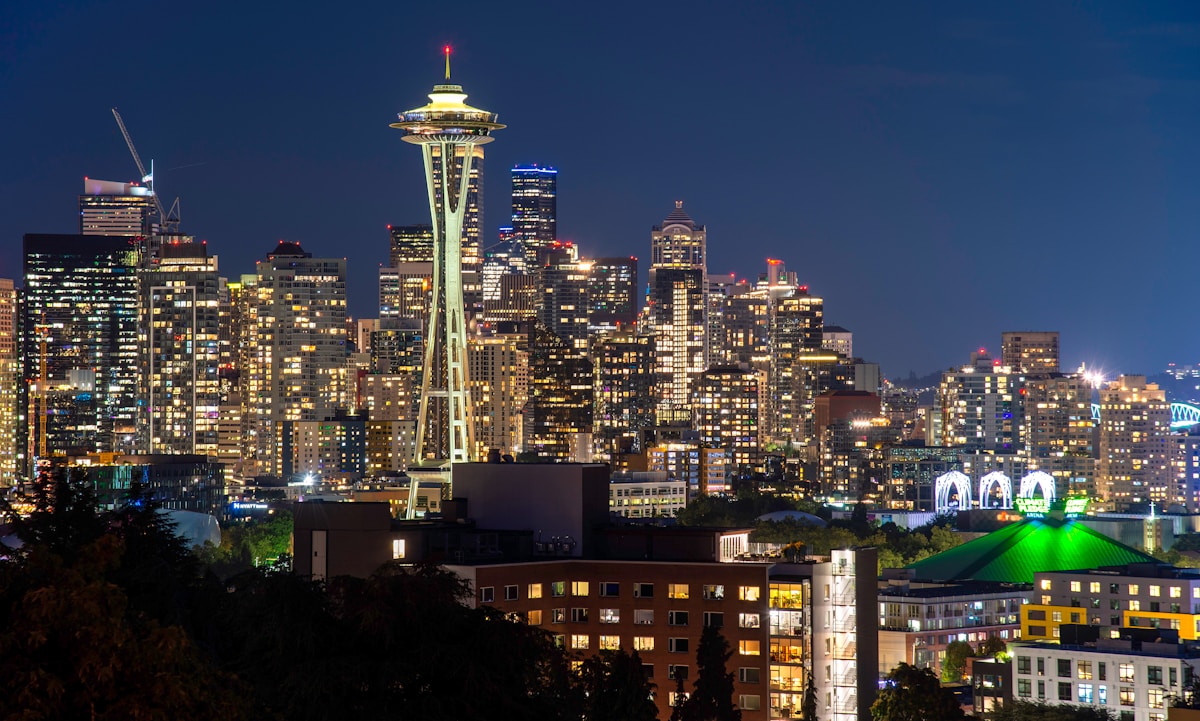
Seattle’s appeal is spread across a compact set of major attractions (Pike Place, the Space Needle, Chihuly Garden and Glass) and a broader range of neighbourhood-level experiences-the craft brewery scene in Ballard, the music history of Capitol Hill, the salmon-run viewing at the Ballard Locks, and the ferry rides across Puget Sound that give the best views of the city and the Olympics. Day trips to Mount Rainier and the San Juan Islands extend the range considerably.
Pike Place Market
Pike Place Market (1st Ave and Pike St) is a working public market in continuous operation since 1907. Entry is free; open Monday–Saturday 9am–6pm, Sunday 9am–5pm.
The market covers multiple floors below street level as well as the main upper level. The most-visited section is the Main Arcade on the upper level, where the fish-throwing at Pike Place Fish Company happens several times a day when the fishmongers are feeling performative-though you’ll pay tourist prices if you actually buy fish here. The produce stalls, flower vendors, and specialty food shops along the back of the main level are the reason the market has survived for over a century.
Specific stops worth making:
- Pike Place Chowder (1530 Post Alley) - The clam chowder in a sourdough bread bowl is approximately $14–$16 as of 2026; outdoor window service with a seating area. Won a national chowder competition five times; the line is usually 10–20 minutes.
- Piroshky Piroshky (1908 Pike Pl) - Russian savory pastries from approximately $5–$7 each as of 2026; the beef and potato piroshky and the smoked salmon pirozhki are the strongest options.
- Rachel the Pig - The market mascot; a 550-pound bronze piggy bank at the main entrance where you can deposit change for market-related charities.
Post Alley, which runs behind and below the market, contains the Gum Wall (around 1428 Post Alley) - approximately 50 feet of used chewing gum pressed onto the wall in a multi-coloured mass. A genuine piece of outsider art or a hygiene nightmare, depending on your perspective; free to view.
Space Needle and Seattle Center
The Space Needle (400 Broad St) was built for the 1962 World’s Fair and has been the city’s visual identifier since. Admission approximately $40 as of 2026 for the observation deck at 520 feet; the rotating glass floor (added in 2018) costs an additional $8 and is genuinely disorienting in a good way. Open daily 10am–7pm (later on weekends). Book online to save approximately $5 and to avoid queuing.
Adjacent to the Space Needle, Chihuly Garden and Glass (305 Harrison St) is a dedicated museum for Dale Chihuly’s large-scale glass installations. Admission approximately $32 as of 2026; open daily 10am–6pm. The interior galleries and the Glasshouse (a 40-foot-tall all-glass greenhouse filled with a massive chandelier sculpture) are the highlights. A combined Space Needle + Chihuly ticket is approximately $62.
The Museum of Pop Culture (MoPOP) (325 Fifth Ave N) is in the Frank Gehry–designed building next to the monorail terminal. Admission approximately $32 as of 2026; open daily 10am–5pm. The Jimi Hendrix gallery (extensive primary collection of instruments, clothing, and archives) and the Nirvana exhibition are the most historically specific. MoPOP is better than its tourist-attraction status suggests; allow 2 hours.
The Seattle Center Monorail runs from the Westlake Center (downtown) to the Seattle Center in approximately 2 minutes; fare approximately $3.50 roundtrip as of 2026. It’s the fastest way to get between downtown and Seattle Center during traffic.
Pioneer Square Underground Tour
The Bill Speidel Underground Tour (614 First Ave, Pioneer Square) takes you below the current street level of Pioneer Square to the original street level that existed before Seattle regraded its streets after the 1889 Great Fire. The city raised street grades by 10–35 feet, leaving the original ground floors of buildings underground. Tours run daily approximately every 30 minutes 10am–5pm; approximately $26 per adult as of 2026. The tour is genuinely informative and often amusing; the guides are trained storytellers.
Pioneer Square itself-the brick Victorian-era neighbourhood immediately south of downtown-is also worth walking. The Klondike Gold Rush National Historical Park (319 Second Ave Ext S) has a free museum about the 1897 gold rush that put Seattle on the map. Open daily 9am–5pm.
Ballard Locks and Brewery Scene
Hiram M. Chittenden Locks (3015 NW 54th St, Ballard) - Also called the Ballard Locks; the facility that connects the salt water of Puget Sound to the fresh water of Lake Union and Lake Washington. Free to visit; open daily. The fish ladder viewing window allows observation of salmon moving upstream from approximately June through November (peak typically September–October). The botanical garden on the south bank is also free and pleasant.
Ballard’s Brewery Row - Ballard has the highest concentration of craft breweries in Seattle, several of them within walking distance of each other. Reuben’s Brews (5010 14th Ave NW), Populuxe Brewing (826 NW 49th St), and Stoup Brewing (1108 NW 52nd St) are the most consistently rated. Pints approximately $6–$9 as of 2026; tasting flights typically $12–$18 for four to six pours.
Fremont
Fremont is the self-styled “Center of the Universe” and has enough character to earn a half-day visit.
Fremont Troll (N 36th St under the Aurora Bridge) - A large concrete troll sculpture installed in 1990 underneath the Aurora Bridge; free to visit, 24/7. A piece of public art that has become genuinely beloved.
Fremont Sunday Market (Evanston Ave N and N 34th St) - Open-air flea market and craft fair, Sundays 10am–4pm, April through October; free to enter. A good place to buy vintage clothing, antiques, and local art.
Troll Brewing and Fremont Brewing are both here; Fremont Brewing’s Urban Beer Garden (1050 N 34th St) is one of the better outdoor drinking spots in the city; open from noon. Pints approximately $6–$8 as of 2026.
Day Trip: Mount Rainier
Mount Rainier National Park is approximately 90 miles southeast of Seattle by rental car; allow 2–2.5 hours. Entry is approximately $35 per vehicle as of 2026, valid for 7 days.
The Nisqually Entrance on the southwest side gives the most direct access to the park’s most visited area: Paradise at 5,400 feet elevation. The Henry M. Jackson Visitor Center at Paradise is open daily in summer; the Skyline Trail from Paradise (a 5.5-mile loop with approximately 1,700 feet of elevation gain) gives the best views of the Nisqually Glacier and the summit. The wildflower meadows around Paradise are at their peak in late July and August.
An alternative approach via the Stevens Canyon Entrance (southeast) passes Reflection Lakes-some of the best photography angles of the mountain-before reaching Paradise. The Sunrise area (northeast side) at 6,400 feet is the highest point reachable by paved road in Washington State; open approximately July–September only.
Day Trip: San Juan Islands
The San Juan Islands-approximately 170 islands in the Salish Sea between Washington State and Vancouver Island-are accessible by Washington State Ferries from Anacortes (approximately 90 minutes north of Seattle by car). The ferry to Friday Harbor on San Juan Island takes approximately 1.5 hours; round-trip fares approximately $25 per passenger plus $65–$85 per vehicle as of 2026.
San Juan Island is the most visited; wildlife includes southern resident orca whales (primarily May–September, not guaranteed), bald eagles, and Steller sea lions. The island is small enough to cycle; bike rentals available in Friday Harbor from approximately $35/day as of 2026.
Practical Tips
- The Link Light Rail is the most reliable way to get between the airport and downtown; avoid rideshares during commute hours when traffic is severe.
- Parking is scarce and expensive downtown ($25–$45/day). If driving to the Seattle Center, the Seattle Center Parking Garage (305 Harrison St) is approximately $10–$18 depending on duration.
- The ORCA card (transit smart card) covers Link Light Rail, buses, and streetcars; load it at any Link station and use tap-on/tap-off.
- July through September is the dry, sunny window. Most outdoor activities are significantly more pleasant in this period; accommodation prices are also at their peak.
Search hotels in Seattle on Booking.com
Guided Tours Worth Booking in Advance
| Tour | Duration | From | Book |
|---|---|---|---|
| Pike Place Market Guided Tasting Tour | 2 hrs | $69 | Book |
| Pike Place Market Chef-Guided Food Tour | 2 hrs | $70 | Book |
| Pike Place Market Food Tour with 9+ Tastings | 2–3 hrs | $74 | Book |
| Seattle Underground Walking Tour | 1–1.5 hrs | $31 | Book |
| Space Needle + Chihuly Garden & Glass Ticket | Self-guided | $78 | Book |
Browse all Seattle tours and activities on GetYourGuide - free cancellation on most bookings up to 24 hours before departure.