Sacramento is California’s capital and its most underestimated city. Travelers passing through on their way to Napa or Tahoe frequently spend a few hours at Old Sacramento and leave thinking they’ve seen it - they haven’t. The California State Railroad Museum is legitimately world-class; the Crocker Art Museum is the oldest public art museum in the American West; and the Midtown restaurant and bar scene (centered on J and K Streets through the lettered grid) consistently outperforms expectations for a state capital of 530,000. The city’s proximity to three distinct Northern California destinations (Napa Valley, Lake Tahoe, Gold Country) makes it an efficient base for the region.
California State Railroad Museum
125 I St, Old Sacramento. The largest railroad museum in the United States by collection size and one of the most visited, with 21 restored locomotives and cars spanning the 1860s through the 20th century. The Central Pacific Railroad’s equipment - built during the transcontinental railroad construction of the 1860s - is the core of the collection.
Highlights include the Governor Stanford (Central Pacific’s first locomotive, 1862), the C.P. Huntington (an 1863 working model locomotive), and the Gold Coast sleeping car from the 1926 Southern Pacific daylight era. A full-scale recreation of a Central Pacific construction camp in the Sierra Nevada shows the working conditions of Chinese laborers who built the western half of the transcontinental line.
The museum’s rotating exhibit galleries have covered California agricultural railroads, the mail car system, and railroad labor history. There is also a simulator where visitors can experience operating a locomotive.
Admission approximately $15 adults, $7 children (ages 6–17) as of 2026; children under 6 free. Open daily 10am–5pm. Allow 2–3 hours. The museum anchors the Old Sacramento Historic District and can be combined with other museums here in a half-day.
Old Sacramento Historic District
The four-block waterfront area between I and L Streets and Front and 2nd Streets, along the Sacramento River. The 1850s Gold Rush-era commercial buildings - brick facades, wooden boardwalks, iron shutters designed to stop fire spread - have been preserved at a scale unusual in California, where most 19th-century downtown fabric was demolished or burned.
Museums within Old Sacramento:
- Sacramento History Museum (101 I St) - local history from Maidu people through the Gold Rush and riverboat era; approximately $8 adults as of 2026; open Tuesday–Sunday
- Wells Fargo History Museum (1000 2nd St) - the company’s role in Gold Rush-era banking and express delivery, including original Concord stagecoaches; free admission
- Discovery Museum Science & Space Center - a children’s science museum adjacent to the district
The Sacramento River boardwalk runs along the district’s western edge, with views toward the Tower Bridge and West Sacramento. The riverfront is walkable for a mile in both directions.
| Tour | Duration | From | Book |
|---|---|---|---|
| Old Sacramento Ghost Tour (Shadows, Scandals & Secrets) | 1 hr | $24 | Book |
| City Cruises River Cruise with History Guide | 1.5 hrs | $30 | Book |
| City Cruises Sights and Sips Cocktail Cruise | 2 hrs | $35 | Book |
| Yolo Countryside Guided Rail Bike Tour | 2 hrs | $75 | Book |
Browse all Sacramento tours and activities on GetYourGuide - free cancellation on most bookings up to 24 hours before departure.
California State Capitol and Capitol Park
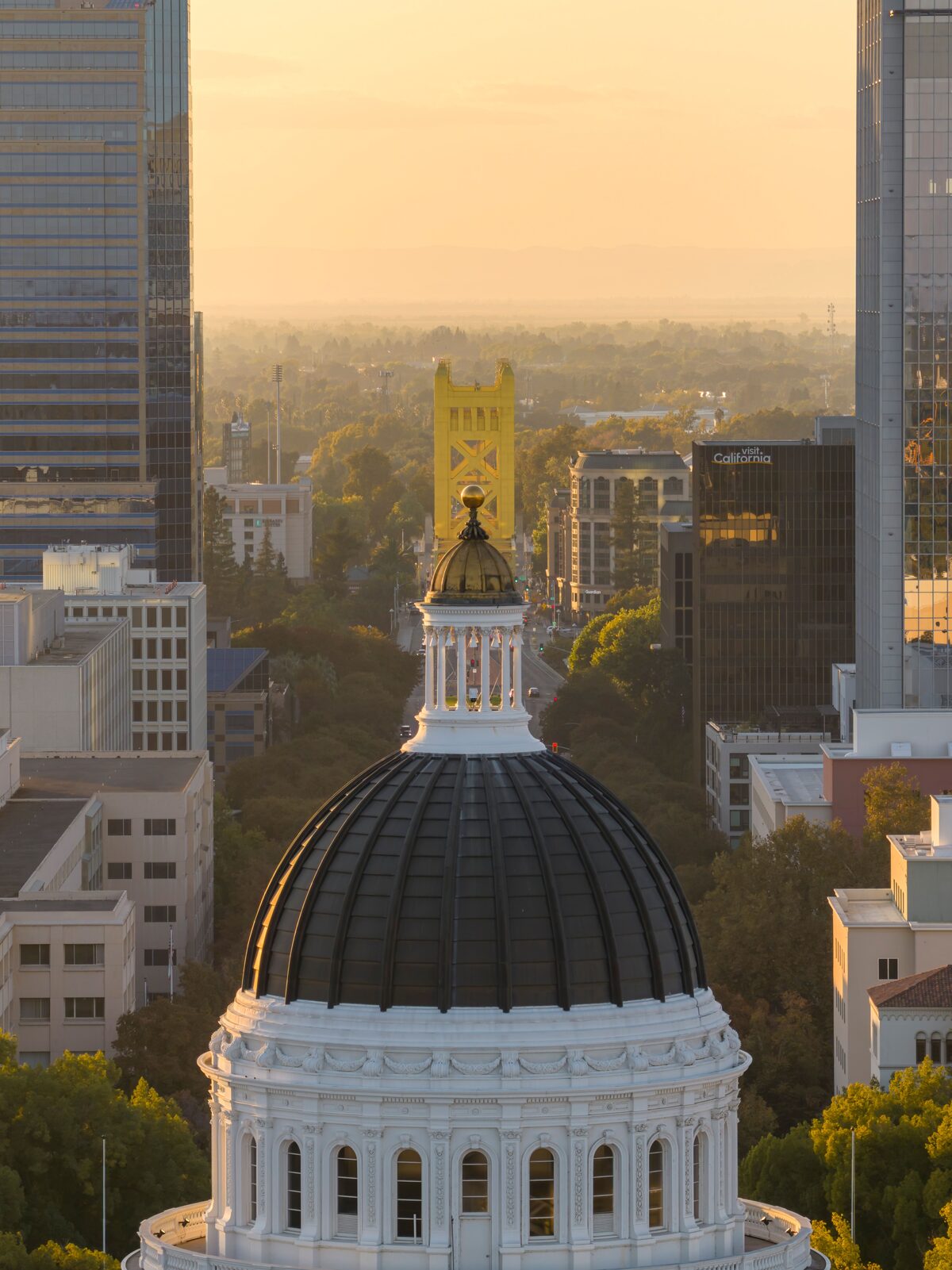
10th and L Streets, downtown Sacramento. The 1869 neoclassical Capitol building was modeled on the US Capitol in Washington DC and houses the working seat of California state government. Free guided tours depart from the south extension visitor center Monday–Friday 8:30am–4:30pm, Saturday 9:30am–3:30pm, Sunday noon–4:30pm. Self-guided tours are available during the same hours. The legislative chambers are open to visitors when the Legislature is not in session.
Capitol Park surrounds the building across 40 acres and contains memorials from multiple California communities - the California Firefighters Memorial, the Vietnam Veterans Memorial, and the Peace Officers Memorial among them. The park also has a significant tree collection, including a grove of sequoia trees planted from seeds brought from the Calaveras Big Trees grove in 1861.
The building’s interior is a museum of California political history - portraits of governors dating to the 1850s, original documents, and displays of the Capitol’s restoration in the 1970s (the building was restored to its 1906 Gold Rush-era appearance from a heavily modified 1950s interior).
Crocker Art Museum
216 O St, downtown Sacramento. The oldest public art museum in the American West, founded in 1885 on the collection of Judge Edwin Crocker (brother of railroad magnate Charles Crocker). The Victorian mansion that houses the original collection is architecturally significant - ornate Italianate wood interior, a sculpture gallery, and the judge’s art library. A major contemporary expansion (2010) added gallery space and a glass atrium connecting old and new buildings.
The collection’s strengths: 19th-century California landscapes (the most complete survey of this tradition in California), European Old Masters (including works attributed to Raphael, Rubens, and Tiepolo), a significant Asian art collection, and an active contemporary California art program. The museum hosts the California-Pacific Triennial, one of the region’s main contemporary art surveys.
Admission approximately $18 adults, $5 ages 7–17 as of 2026; free for children under 7. Open Tuesday–Sunday; closed Monday. Allow 1.5–2 hours for the permanent collection.
Tower Bridge and the R Street Corridor
The Tower Bridge (1935) is Sacramento’s most recognizable structure - a vertical lift bridge painted gold that connects downtown to West Sacramento across the Sacramento River. The bridge opens several times daily to allow river traffic; the openings can be checked on the Port of Sacramento schedule.
The R Street corridor runs east from the bridge through Midtown, occupying a former rail freight corridor that has been redeveloped into Sacramento’s most interesting block for restaurants, bars, and arts venues. The stretch between 10th and 20th Streets on R Street has a concentrated cluster of independent dining and craft beverage operations, including Track 7 Brewing (1167 R St, one of Sacramento’s established craft breweries), Orphan Club, and several farm-to-fork restaurant concepts.
The adjacent 16th Street area (sometimes called the Fremont Park neighborhood) extends the Midtown restaurant and coffee culture into a walkable residential streetscape.
American River Parkway
A 32-mile greenway along the American River from Discovery Park (where the American River meets the Sacramento River) to Folsom. The paved trail is one of the most-used urban recreational corridors in California - cyclists, runners, and walkers throughout daylight hours, with access to the river for swimming and fishing at multiple points.
Whitewater rafting on the American River - the South Fork of the American River (accessed via Coloma, approximately 45 miles east) has Class III–IV rapids and is one of the most popular whitewater runs in California. Half-day trips start at approximately $80–$100 per person; full-day trips approximately $120–$150. Most operators are based in Coloma and include bus transport from Sacramento. Season typically April through September.
Folsom Lake - a reservoir at the eastern end of the American River Parkway, approximately 25 miles from downtown Sacramento. Swimming, kayaking, paddleboarding, and fishing. State Recreation Area day-use fee approximately $12 per vehicle. The town of Folsom adjacent to the lake has a historic district worth 30 minutes on its own.
Day Trips from Sacramento
Napa Valley - 60–80 miles southwest via I-80 and CA-12 or CA-128, approximately 1–1.5 hours. The most famous wine region in the United States, with tasting rooms from the mid-range ($30–$50 per person) to the high end ($80–$150). Yountville has the highest concentration of Michelin-starred restaurants in California outside San Francisco; a lunch reservation at The French Laundry (Thomas Keller’s flagship) requires advance planning but is the most celebrated restaurant table in Northern California.
Lake Tahoe - approximately 2 hours east via I-80 (North Shore via Truckee) or US-50 (South Shore). The largest alpine lake in North America at 6,225 feet elevation. Summer activities: swimming, kayaking, paddleboarding, and hiking on the Tahoe Rim Trail. Winter: Palisades Tahoe (formerly Squaw Valley), Northstar, and Heavenly are the main ski resorts.
Gold Country (Highway 49) - the mining towns of the Sierra Nevada foothills start approximately 45 minutes east of Sacramento. Coloma and the Marshall Gold Discovery State Historic Park mark the site of the January 1848 gold discovery that triggered the California Gold Rush. The town of Nevada City (90 miles east) has the best preserved Victorian downtown in the foothills.